My thoughts about Education Humanities, Technology and Digital Culture. Interested on social media tools in educational contexts and
gamification in education.
The 50th anniversary of the World Heritage Convention will be celebrated on 16 November 2022 on the theme "The Next 50 - The future of World Heritage in challenging times enhancing resilience and sustainability."
"Since wars begin in the minds of men and women, it is in the minds of men and women that peace must be built."
UNESCO uses education, science and culture to inform, inspire and engage people everywhere to foster understanding and respect for each other and our planet.
150 States unanimously adopted an ambitious Declaration for Culture at the end of the MONDIACULT 2022 conference, affirming culture as a “global public good” and reflecting countries agreement on a common roadmap to strengthen public policies in this field.
Education:
Arts is a cultural legacy for humanity. A fundamental part of our history that should be kept safe for future generations. They will be educated to appreciate culture.
Students can enjoy art or love the story behind an object or a place. Culture and art in education are an expanding field of educational research and practice informed by investigation into learning through arts experiences.
Students will learn about World Heritage sites, about the history and traditions of their own and other cultures, about ecology, and the importance of protecting biodiversity.
On the 50th anniversary, invite your students to visit the UNESCO World Heritage website. Let them choose whose places they want to admire.
Hoping you will enjoy my suggestions of August. Please include UNESCO World Heritage into your lessons. The 50th anniversary and the Next 50th is important to educate students to participate in heritage conservation in a difficult moment in Europe. They are the next 50th!
"You cannot teach today the same way you did yesterday to prepare students for tomorrow"
John Dewey
UNESCO proclaimed 5 October to be World Teachers’ Day in 1994, celebrating the great step made for teachers on 5 October 1966, when a special intergovernmental conference convened by UNESCO in Paris adopted the UNESCO/ILO Recommendation concerning the Status of Teachers, in cooperation with the ILO.
It is a day to celebrate how teachers are transforming education but also to reflect on the support they need to fully deploy their talent and vocation, and to rethink the way ahead for the profession globally
World Teachers’ Day is co-convened in partnership with the International Labour Organization (ILO), UNICEF and Education International (EI)
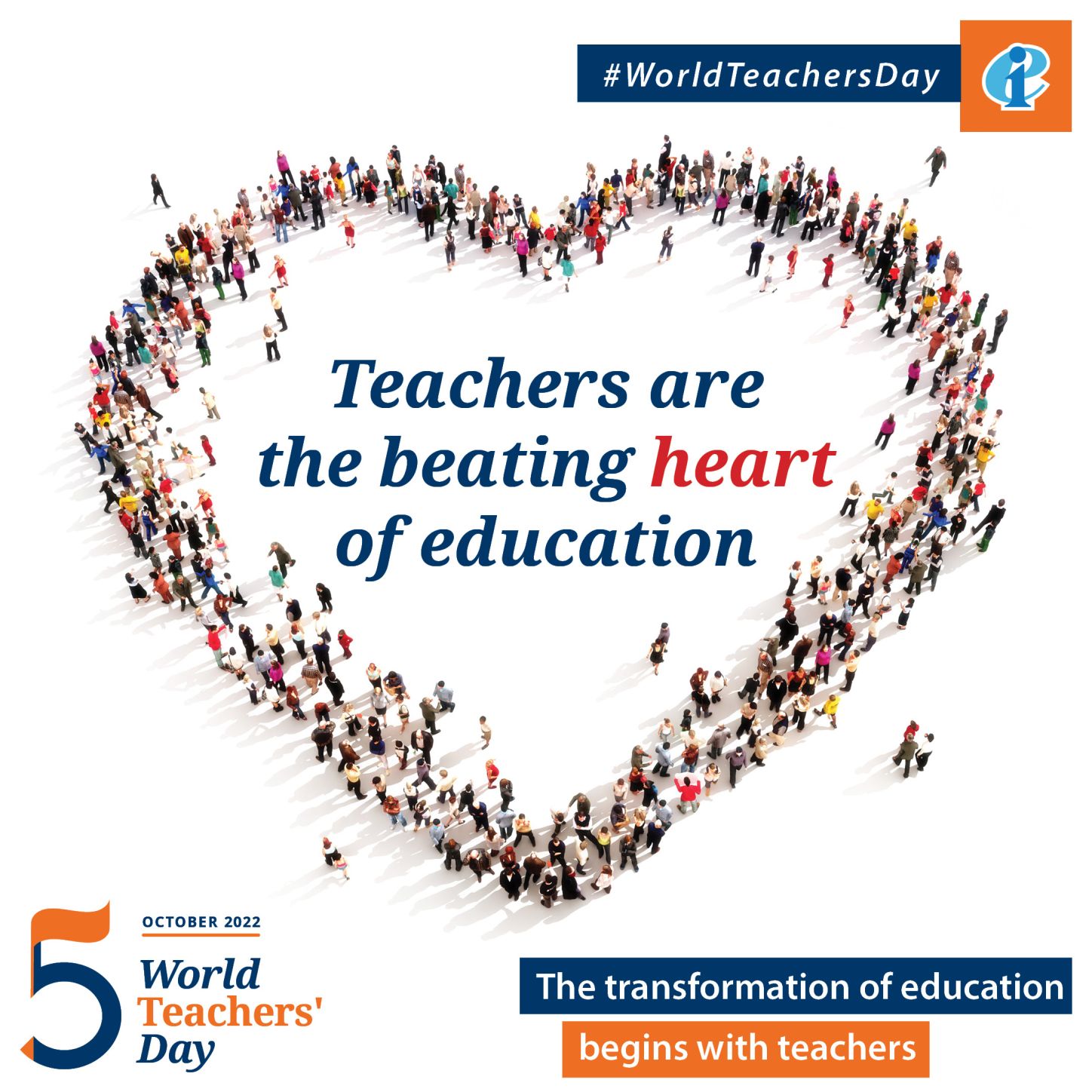
💓Theme 2022:
“The transformation of education begins with teachers”.
“To truly celebrate World Teachers’ Day, we must go beyond thanking teachers. We must invest in quality public education systems. We call on governments everywhere to invest in teachers, guarantee labour rights and good working conditions, involve teachers in decision-making, and trust their pedagogical expertise. The transformation starts with teachers. We are the beating heart of education.”
David Edwards, General Secretary, Education International
Worldwide, 69 million teachers are needed to reach universal basic education by 2030. The largest deficit is in sub-Saharan Africa.
"Lack of training, unattractive working conditions and inadequate funding all undermine the teaching profession and aggravate the global learning crisis. (...) There is an urgent need to better recognise this profession on which the future of our children depends."
Teachers, make your voice heard on social media and highlight teacher leadership in transforming education.
Feel free to use the suggested post and image below:
"Teachers are the beating ❤️ of education."
Education systems were already failing our children even before the pandemic. COVID-19 has exacerbated this learning crisis and children in almost every country have fallen behind in their learning.
We need a global effort to tackle the learning crisis head on. Together, we can help every child gain basic reading and math skills and unlock their potential.
Everyone can help by celebrating the profession, by generating awareness about teacher issues, by ensuring that teacher respect is part of the natural order of things.
Take the opportunity of the day to discuss, compare, learn, argue, share and improve.
Happy Teacher's Day! Don't give up! You're the beat of education!
As my usual readers know, I love music, I have a master degree in Music/Piano. I have been a piano teacher for years. It would be impossible not to write about Music Day.
"Music was my refuge. I could crawl into the space between the notes and curl my back to loneliness."
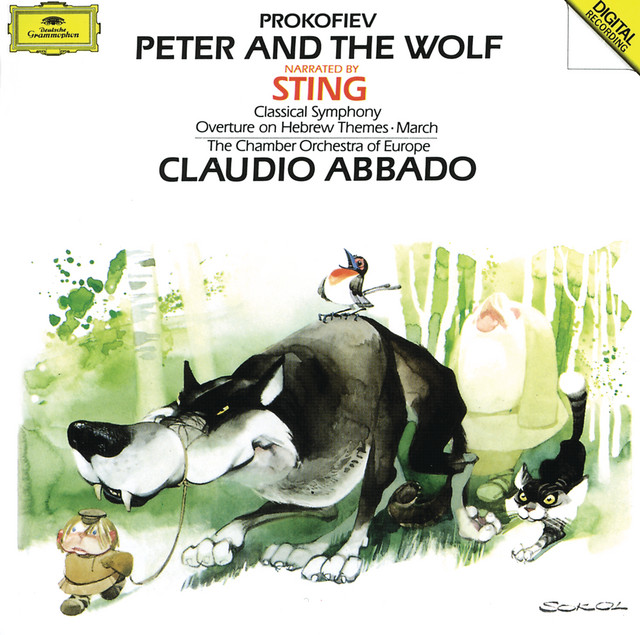
Well, this year to celebrate Music Day, I chose to propose to my usual readers a marvelous symphonic fairy tale for children, Peter and the Wolf, a musical composition written by Sergei Prokofiev in 1936.
The narrator tells a children's story, while the orchestra illustrates it by using different instruments to play a "theme" that represents each character in the story. It is Prokofiev's most frequently performed work and one of the most frequently performed works in the entire classical repertoire. Each character in the story is represented by a Leitmotif played on a unique instrument.
The film based on the story of Peter and the Wolf as set to the music Sergei Prokofiev in 1936. Unlike the usual version of Prokofiev's work, the film has no narrator but relies on music and images to tell the story.
This inviting picture book introduces a new generation of youngsters to the exciting story of the hungry wolf, the ill-fated duck, the fortunate cat, the fearless little bird, and the brave and cunning Peter, who helps save his friends from the wolf's jaws-and the wolf from the hunters' guns.
The film is based on the story of Peter and the Wolf as set to the music Sergei Prokofiev in 1936. Unlike the usual version of Prokofiev's work, the film has no narrator but relies on music and images to tell the story.
Peter and the Wolf
bySergei Prokofiev
Janet Schulman,
Erna Voigt(Illustrator)
via Amazon
A new recording of Prokofiev's music was made to accompany the cinema and television release. The recording was made by the Philharmonia Orchestra and conducted by Mark Stephenson.
Sergei Prokofiev's brilliant compositions are numerous and varied, butPeter and the Wolfis definitely the most evocative and delightful. I listened so many adaptations of this famous work, including editions read by Sting on Spotify, David Bowie, and Basil Rathbone. And I love to watchPeter and the Wolf, the 2008 Oscar-winning stop-motion animated film, which inspired me as well.
Mais, saviez-vous qu'il y a la version de ce conte musical de Sergeï Profiev en français? Ça fait des années! Une version moderne de Pierre et le Loup du grand compositeur et narrateur musical qui d'ailleurs était pianiste.
"Alors, vous vous rappelez bien tous les personnages ? L'oiseau, le canard, le chat, le grand-père, les chasseurs, Pierre... et le LOUP !"
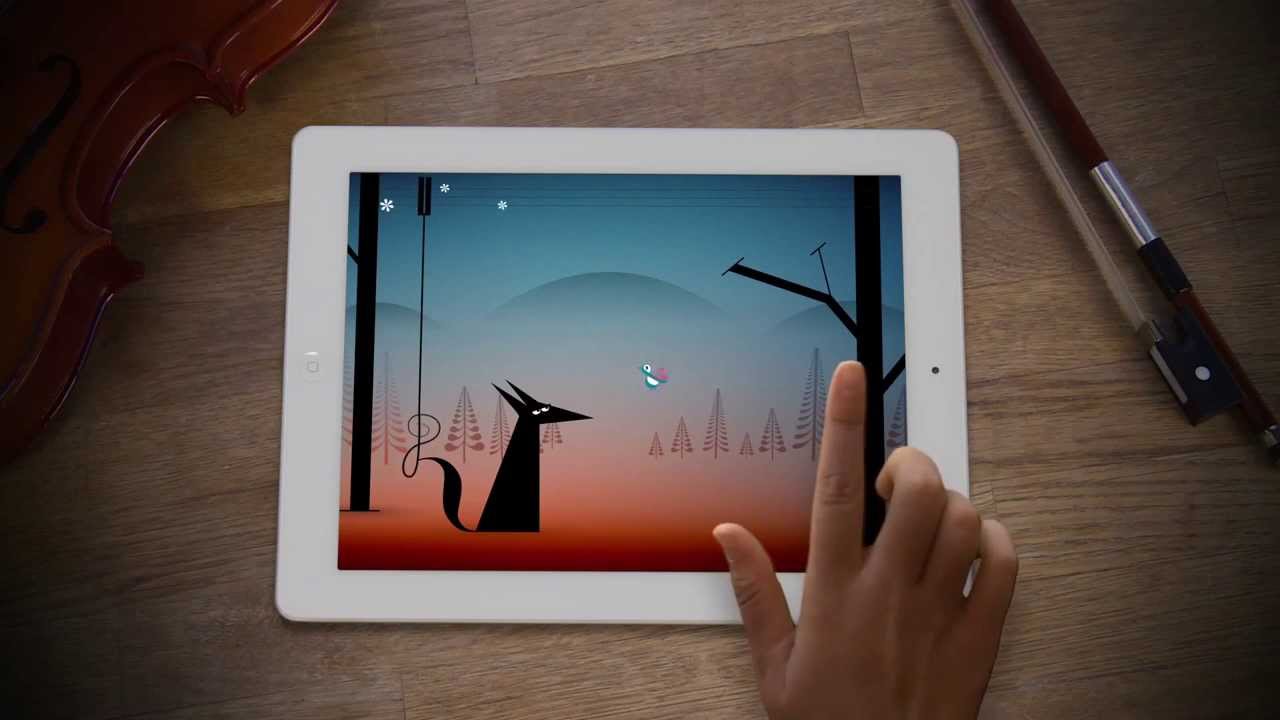
Après le film diffusé à la télévision et l'appli récompensée par le Bologna Ragazzi Digital Award 2014, voici un livre-CD illustré en typographie. Ici, le corps du canard est une esperluète, la casquette de Pierre est un « P »...
Un livre avec des découpes et de grandes pages qui se déploient, tantôt comme une forêt, tantôt comme la gueule menaçante du loup.
Appli pour iPad disponible sur l'App Store français
Quelques-uns ont en mémoire de Pierre et le Loup , le conte musical de Prokofiev que des générations d’enfants ont écouté avec fascination, faisant tourner sur leurs platines le grand 33 tours. C’était il y a des décennies. Gérard Philippe, le grand acteur du cinéma français narrait l’histoire de ce petit garçon chassant le loup dans la campagne russe, invitant les auditeurs à découvrir, par le biais de la narration musicale, les instruments.
La plus mythique version de Pierre et Le Loup de Serge Prokofiev, produite par Le Chant du Monde en 1956, avec Gérard Philippe et Yvonne Loreilhe, accompagné par l´Orchestre Symphonique de l'U.R.S.S. sous la direction de Guennadi Rojdestvenski.
Résumé:
"Voici l'histoire de Pierre et le Loup, une histoire pas comme les autres, une histoire qui vous sera contée en musique et par les instruments de l'orchestre. Comment ? C'est très simple.
Chaque personnage de l'histoire est représentée par un instrument différent qui joue une petite phrase musicale facile à retenir.
Ainsi vous pourrez reconnaître sans peine l'oiseau, le canard, le chat, le Grand-Père, les chasseurs et naturellement Pierre et le loup."
Les compositions brillantes de Sergei Prokofiev sont nombreuses et variées, mais Pierre et le Loup est sans aucun doute la plus évocatrice et la plus charmante.
Google Doodle 120th of Birthday of Sergei Prokofiev
Les petits auditeurs se familiarisent ainsi avec les divers sons de l'orchestre. Dans cette nouvelle adaptation innovante, mélangeant animation et prises de vues réelles, le comédien François Morel narre l'histoire avec beaucoup d'humour. Trop beau!
Réalisé par Gordon, Pierre-Emmanuel Lyet, Corentin Leconte en 2013
Pierre et le Loup est à la fois un conte musical et une œuvre pédagogique : elle a pour but d’aider les enfants à connaître et reconnaître les instruments de musique de l’orchestre, en les associant à des personnages et des animaux. Prokofiev explique cela très clairement dans la préface de l’œuvre :
"Chacun des personnages de ce conte est représenté par un instrument de l’orchestre : l’oiseau par la flûte, le canard par le hautbois, le chat par la clarinette staccato dans un registre grave, le grand-père par le basson, le loup par des accords de trois cors d’harmonie, Pierre par le quatuor à cordes, les coups de feu des chasseurs par les timbales et la grosse caisse. Avant l’exécution, il est préférable de présenter ces divers instruments aux enfants et de leur jouer des leitmotivs. De cette façon, ils apprendront sans effort à identifier les différents instruments de l’orchestre."
At the request of the Central Children’s Theatre in Moscow, Prokofiev wrote Peter and the Wolf as a musical symphony for children to cultivate children’s musical tastes from a young age. Many U.S. children still encounter this timeless tale in elementary school.
The story tells the tale of Peter, a young boy, his grandfather and a bunch of animals. Each character in the story is also represented by a specific musical instrument. Peter gets an upbeat violin melody; his grandfather a bumbling bassoon.
Each of the various animals also get their own instruments: a flute for the bird, oboe for the duck, clarinet for the cat, French horns for the wolf and various woodwinds and drums for the hunters who save the day.
Children learn to distinguish the sounds of the instruments during the performance of this tale.
via Colorado State University
Many studies have emerged in recent years describing the cognitive, emotional, and behavioral benefits of music education for children.
Singing and playing music is one of the most effective ways to help young people learn. The benefits include a longer attention span, emotional stability, resilience and cognitive capacity.
Nearly everyone enjoys music, whether by listening to it, singing, or playing an instrument. But despite this almost universal interest, many schools are choosing to do away with their music education programs.
This is a mistake, with schools losing not only an enjoyable subject, but a subject that can enrich students’ lives and education.
Music education is so important, and it offers benefits even beyond itself.
Music is the divine way to tell beautiful, poetic things to the heart.