Showing posts with label children-s rights. Show all posts

Thursday, October 17, 2019

Schools : Intl Day for the Eradication of Poverty : #EndPoverty !


#EndPoverty
credits: Elyx Yak

"One of the keys to ending child poverty is addressing poverty in the household, from which it often stems. Access to quality social services must be a priority."

António Guterres, UN, Secretary-General


credits: UN

This year marks the 30th anniversary of the adoption of the Convention on the Rights of the Child (UNCRC) on 20 November 1989. This landmark human rights treaty sets out the civil, political, economic, social and cultural rights of every child, regardless of their race, religion or abilities.
In particular, the Convention recognizes the right of every child to a standard of living adequate for the child’s physical, mental, spiritual, moral and social development. Poverty hurts children’s development and, in turn, leads to lower income and health in adulthood. When child poverty is recognized as a denial of children’s human rights then people in positions of responsibility and power are legally bound to promote, protect and fulfil children’s rights. Above all, it is imperative to recognize and address the specific discriminations experienced by the girl child.


UN Photo/Leonora Baumann

In a world characterized by an unprecedented level of economic development, technological means and financial resources, that millions of persons are living in extreme poverty is a moral outrage. Poverty is not solely an economic issue, but rather a multidimensional phenomenon that encompasses a lack of both income and the basic capabilities to live in dignity.
Persons living in poverty experience many interrelated and mutually reinforcing deprivations that prevent them from realizing their rights and perpetuate their poverty, including:

  • dangerous work conditions
  • unsafe housing
  • lack of nutritious food
  • unequal access to justice
  • lack of political power
  • limited access to health care


2019 Theme: 


"Acting Together to Empower Children, their Families and Communities to End Poverty."


It is crucial that children’s participation be recognized as a process and not a one-off event. Too often consultation is mistaken for participation. Whereas the process of consultation gathers children’s views on a particular issue or question, participation means that children actually join in in decision- making.


An alarmingly high number of children are suffering the consequences of poor diets and a food system that is failing them, UNICEF warned today in a new report on children, food and nutrition.

For the first time in 20 years, UNICEF’s flagship report examines the issue of children, food and nutrition, providing a fresh perspective on a rapidly evolving challenge.
The 2019 edition of The State of the World’s Children (SOWC) examines the issue of children, food and nutrition, providing a fresh perspective on a rapidly evolving challenge.


Children, food and nutrition
UNICEF


"Despite progress in the past two decades, one third of children under age 5 are malnourished – stunted, wasted or overweight – while two thirds are at risk of malnutrition and hidden hunger because of the poor quality of their diets. At the center of this challenge is a broken food system that fails to provide children with the diets they need to grow healthy."

This report also provides new data and analyses of malnutrition in the 21st century and outlines recommendations to put children’s rights at the heart of food systems.


Education:

When child poverty is recognized as a denial of children’s human rights, people in positions of responsibility and power are legally bound to promote, protect and fulfil children’s rights."
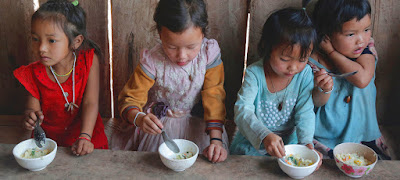
The report provides the most comprehensive assessment yet of 21st century child malnutrition in all its forms. It describes a triple burden of malnutrition:
Undernutrition, hidden hunger caused by a lack of essential nutrients, and overweight among children under the age of five, noting that around the world:

• 149 million children are stunted, or too short for their age,
• 50 million children are wasted, or too thin for their height,
• 340 million children – or 1 in 2 – suffer from deficiencies in essential vitamins and nutrients such as vitamin A and iron,
• 40 million children are overweight or obese.


credits: UNICEF/Jacqueline Labrador

  • Join the #EndPoverty global campaign.

Everyone can join the campaign on social media by using hashtag #EndPoverty and promoting the call to action to connect with people from around the world who have joined the fight to overcome poverty.


Children, food and nutrition


Activities:

Activities and other resources: Learn more here

Ask students to use #EndPoverty to share messages about the International Day for the Eradication of Poverty via social media.


G-Souto 

17.10.2019
Copyright © 2019G-Souto'sBlog, gsouto-digitalteacher.blogspot.com®

Creative Commons License
Schools : Intl Day for the Eradication of Poverty : #EndPoverty by G-Souto is licensed under a Creative Commons Attribution-NonCommercial-NoDerivatives 4.0 International License.

sources:

UNICEF/ UN

Wednesday, June 12, 2019

Schools : World Day Against Child Labour : Children must work on dreams ! Resources


World Day Against Child Labour

The International Labour Organization (ILO) launched the World Day Against Child Labour in 2002 to focus attention on the global extent of child labour and the action and efforts needed to eliminate it. 
Each year on 12 June, the World Day brings together governments, employers and workers organizations, civil society, as well as millions of people from around the world to highlight the plight of child labourers and what can be done to help them.
2019 also marks 20 years since the adoption of the ILO's Worst Forms of Child Labour Convention, 1999 (No. 182).

Theme 2019: 


"Children shouldn’t work in fields, but on dreams!


Children shouldn’t work in fields, but on dreams. Yet today, 152 million children are still in child labour. Although child labour occurs in almost every sector, seven out of every ten is in agriculture.


Mohammed, 14, a Syrian refugee from Kobani, 
works underneath a car at a repair shop in Erbil, Iraq in March 2016

In 2019, the International Labour Organization celebrates 100 years of advancing social justice and promoting decent work. 

"On this World Day Against Child Labour will look back on progress achieved over a 100 years of ILO support to countries on tackling child labour."


100 Social Justice, Decent Work (1919-2019)

The World Day Against Child Labour looks back on progress achieved over a 100 years of ILO support to countries on tackling child labour. Since its founding in 1919, the protection of children has been embedded in the ILO’s 

"Take immediate and effective measures to eradicate forced labour, end modern slavery and human trafficking and secure the prohibition and elimination of the worst forms of child labour, including recruitment and use of child soldiers, and by 2025 end child labour in all its forms."

UN/ILO

100 Social Justice, Decent Work (1919-2019)

Education:

Schools and other educational institutions make a special effort to inform children of their rights according to the Declaration of the Rights of the Child and the Convention on the Rights of the Child. 

Teachers and students worldwide are speaking out against child labour in the classroom and taking action to raise further awareness of this issue out school. 

They are spreading knowledge among their peers, acting as a voice for those children whose rights are not respected and calling on decision-makers to act urgently to protect children in danger. 


World Day Against Child Labour


Teachers have a crucial role on the alert of poverty or child labour, modern slavery cases among their students.

Numerous resources can be included into school curricula to inform, inspire and motivate students of all ages, from primary school through university, on the subject of child labour, modern slavery and human trafficking.


Resources:

  • Book:


The Little Hero
One boy's Fight to End Child Slavery
Andrew Crofts, 2006

Iqbal Masih was gunned down by an assassin in cold blood in 1995. He was just 13 years old. 

The book tells the heart-wrenching story of this courageous child martyr, who died trying to end child slavery. After six years of bonded labour in a Pakistani carpet factory, Iqbal escaped the clutches of his tyrannical carpet-master, and then tirelessly worked to spread the word to other enslaved children that they could be free too. 

He addressed international conventions on behalf of the Bonded Labour Liberation Front and participated in raids on illegal factories. He was awarded the Reebok 'Youth in Action' Award, and a scholarship to study law in Boston. But before he could study, his life was cut short by a hail of bullets from the gun of an unknown sympathiser.


  • Animation (French language)

"Iqbal, l'enfant qui n'avait pas peur" (2016)
Film d'animation librement inspiré de l’histoire vraie d'Iqbal Masih, un enfant pakistanais réduit à l’esclavage dès ses quatre ans pour rembourser la dette familiale. A 9 ans, il fuit l’usine de tapis dans laquelle il travaille enchaîné douze heures par jour.


Iqbal, l'enfant qui n'avait pas peur
 Michel Fuzellier et Babak Payami, 2015

Grâce à un avocat qui lui vient en aide, Iqbal est devenu Ã  10 ans l'une des figures mondiales de la lutte contre l’esclavage moderne, multipliant les interventions dans des conférences internationales pour l’UNICEF ou devant les Nations Unies à New-York. Il a été tué en 1995. Il n'vait que 13 ans.

Outil pédagogique: Dossier 

Ce dossier s’adresse aux enseignants, animateurs des structures périscolaires et de loisirs, et aux chargés d’actions éducatives de l’UNICEF qui interviennent auprès d’enfants de 8 à 11 ans. A consulter ici

Vu sur: https://my.unicef.fr/contenu/iqbal-lenfant-qui-navait-pas-peur


Other resources:


Historical slideshow here

Posters 2019 to download here


"To die will be an awfully big adventure."

J M Barrie, Peter Pan, 1928


G-Souto

12.06.2019
Copyright © 2019G-Souto'sBlog, gsouto-digitalteacher.blogspot.com®

Creative Commons License

Saturday, April 6, 2019

Schools : Intl Day of Sport 4 Peace & Development : Resources & activities


International Day of Sport
for Development and Peace


"Regardless of age, gender or ethnicity, sport is enjoyed by all; its reach is unrivalled. More importantly, though, sport promotes universal values that transcend language and culture, particularly inclusion. History abounds with examples of inspiring stories of how expanding sporting opportunity leads to greater inclusion in society overcoming prejudice against women, ethnic minorities and people living with a disability."

Audrey Azoulay, Directrice générale UNESCO

Today, the 6 April we are celebrating the 6th International Day of Sport for Development and Peace. 


In August 2013(link is external)the UN General Assembly made the decision to proclaim 6 April as the International Day of Sport for Development and Peace.


Indeed, the values acquired in and through sport – such as fair play and a team spirit – are invaluable to the whole of society.

Due to its vast reach, unparalleled popularity and foundation of positive values, sport is ideally positioned to contribute towards the United Nations’ objectives for development and peace. 

Sport has historically played an important role in all societies, be it in the form of competitive sport, physical activity or play. But one may wonder: what does sport have to do with the United Nations? In fact, sport presents a natural partnership for the United Nations (UN) system.


International Day of Sport
for Development and Peace


Sports encourage:

  • Individual development
  • Health promotion and disease prevention
  • The promotion of gender equality
  • Social integration and the development of social capital
  • Peace building and conflict prevention/resolution
  • Post-disaster/trauma relief and normalisation of life
  • Economic development
  • Communication and social mobilisation


The adoption of this Day signifies the increasing recognition by the United Nations of the positive influence that sport can have on the advancement of human rights, and social and economic development.


“Sport has the power to change the world”.

Nelson Mandela


Sport can no longer be considered a luxury within any society but is rather an important investment in the present and future, particularly in developing countries.


International Day of Sport
for Development and Peace
UNESCO


Education:

Education in the 21st century increasingly recognizes the role of values and social skills in tackling global challenges, such as inactivity, obesity, unemployment, and conflict. This approach is at the core of the Sustainable Development Goal 4 on quality education, which advocates for inclusive lifelong learning opportunities and innovative content delivery.

  • Values:

Dynamic forms of values-based education using sport can be introduced in schools to support teachers deliver curricula actively and cooperatively.


SDG
credits: Elyx Yak


Sport can teach values such as fairness, teambuilding, equality, discipline, inclusion, perseverance and respect.

Sport has the power to provide a universal framework for learning values, thus contributing to the development of soft skills needed for responsible citizenship.

  • What can Values Education through Sport offer?


Values Education through Sport (VETS) programmes support active learning, complement cognitive skills and give students increasing amounts of responsibility, and enhance their level of concentration and participation.

VETS programmes are flexible and have a strong cross-curricular potential: they can reinforce existing curricula and can be streamed across different subjects, including physical education, civic and moral education, nutrition, biology, arts.

Ultimately, these programmes help students to transfer and put values into action.


T
oday, 1 in 4 adults worldwide is not active enough. For adolescents, the statistics are much worse. Lack of physical activity is also the leading cause for cardiovascular diseases such as cancer and diabetes. An active world is a healthier world for all. 


On 6 April, we celebrate the International Day of Sport for Development and Peace as a reminder that sport benefits us all mentally and physically as it aims to create a more sustainable global future. 


Sport is a pillar of a healthy society, at ease with itself, united in its diversity, based on human rights and equal dignity. It provides a field for passions to be shared, for communities to come together, for the disadvantaged to be empowered.


Kids & sport


Play is not only a child’s inalienable right – it also influences physical, socio-emotional and cognitive development. 

The right to play is protected in Article 31 of the Convention on the Rights of the Child, as well as the right to sport, which is specifically contained in other international treaties. 


via IAAF


"The broad consensus that regular physical activity is essential for the physical, mental, psychological and social development of children and adolescents. Involvement in sport can boost children’s health, improve academic performance and help reduce crime." 

UNICEF


via Yoga Journal

Weekend for students and teachers. But on Monday or during two-three days, even a week of sport teachers must propose different sportive activities for their students at school. 


Activities:

  • Organize a match, a yoga lesson, a tournament or games to raise awareness among participants about the formative values of sport 
  • Rally your school around a group action representing 6 April (parade, run for peace, flash mob, photo or video conveying a particular message, other).
  • Bring a sports personality, specialist or influential people from your community to lead a workshop with your students, or discuss the impact of sport on society.
  • Give free rein to your imagination and demonstrate to your students how sport can be a tool for peace and development (exhibition, dance, drawing).


In every society, sport is a field of dreams and a force for fabulous positive change - we must do everything to harness this power. 


credits: UNESCO


  • Links
Getting into the game | UNICEF

About the Sport Programme | UNESCO


G-Souto

06.04.2019

update 06.04.2025
Copyright © 2019G-Souto'sBlog, gsouto-digitalteacher.blogspot.com®

Creative Commons License
Schools : Intl Day of Sport 4 Development & Peace : Resources & activities by G-Souto is licensed under a Creative Commons Attribution-NonCommercial-NoDerivatives 4.0 International License.