Showing posts with label languages curricula. Show all posts

Friday, September 25, 2020

European Day of Languages 20 Years : Celebrate at school or at home ! New resources & activities !


20th Anniverversary of the European Day of Languages


European Day of Languages

European Day of Languages 2021: 20 years celebrating linguistic and cultural diversity.


Throughout Europe, 800 million Europeans are represented in the Council of Europe's 47 member states and all are encouraged to discover more languages at any age, as part of or alongside their studies. This stems from the Council of Europe’s conviction that linguistic diversity is a tool for achieving greater intercultural understanding and a key element in the rich cultural heritage of our continent. Therefore, the Council of Europe, in Strasbourg, promotes plurilingualism in the whole of Europe. 


At the Council of Europe’s initiative, the European Day of Languages has been celebrated every year since 2001 on 26 September - together with the European Commission.


European Day of Languages

https://edl.ecml.at/


"The European Day of Languages gives us an opportunity to value and promote all languages and cultures in Europe. This year we are putting a special focus on inclusive language education, which supports all learners to reach their potential and play an active part in diverse and democratic societies”


It is estimated that there are over 225 indigenous languages in Europe, without even including languages which have arrived on the continent through migration.


Secretary General Marija Pejčinović Burić


The specific aims of the EDL are to:


  • raise awareness of the importance of language learning in order to increase plurilinguism and intercultural understanding;
  • promote the rich linguistic and cultural diversity of Europe;
  • encourage lifelong language learning in and out of school.


European Day of Languages

https://www.facebook.com/EuropeanDayofLanguages/


  • Education:

A dedicated website, which is available in 41 languages (some partly), provides details of the hundreds of events taking place in celebration of the Day, as well as a wide variety of resources and activities for everyone interested in languages and language learning.


💙New! Activities :


https://edl.ecml.at/Portals/


Poster :  "20 things you might not know about Europe's languages"


In 10 languages. 


App EDL


App: The secret agent’s language challenges app :

The challenges and quizzes contained within this app encourage learners – future international agents – to take advantage of the plentiful opportunities available to practice or learn more about a language beyond a classroom context. 

By passing through a series of levels you can rise from a lowly agent in training to become a master secret agent. 

Students can compete with friends and schoolmates in achieving challenges, identifying countries and languages and completing quizzes. 

The challenges go from the easy, such as, “count from 1-10 in 3 different languages within one minute” to ones that are a bit more demanding, “together with a friend, write the words to a song/rap in a foreign language.


Great Bake-Off

https://edl.ecml.at/


  • Join EDL's 20th Anniversary Great Bake-Off 


This year, to commemorate the 20th anniversary of its inauguration, the European Centre for Modern Languages invites all of you to participate in our EDL's Great Bake-Off.


The goal is to collect birthday recipes from different parts of the world and in different languages to then include the 20 most original (and tasty!) desserts in a special 20th-anniversary-edition recipe book


If you would like your birthday dessert to be included (after a rigorous selection process!), please read the instructions and get ready to bring out the chef in you!

Submission deadline: 30 September 2021


Note: 


Great Book - Off receipe book

https://edl.ecml.at/Portals/


And here's the book Back-off with the most delicious sweet dessert recipes made by many students from different countries and languages ​​celebrating the European Day of Languages that it's celebrating its 20th anniversary.


It includes the 20 best recipes! Congratulations to the winners!!


Lara Language Journey
Across Europe


  • Lara's language journey across Europe:

During this short journey, students will discover lots of similarities. European languages largely fall into three main categories: Slavic, Romance and Germanic, the languages within each group have the same roots – however, over centuries they have developed in their own distinct directions. You will also find out about their differences: the variety of alphabets (such as Latin, Cyrillic, Greek, Armenian and Georgian), often using artistic scripts; how they deal with creating words for new inventions and their sometimes mysterious origins. All have a unique identity and their own story to tell! 
Download book here


hybrid learning cartoon
credits. Freepik


Struggling to find ideas for a ‘socially-distanced’ event for this year’s European Day of Languages? In these uncertain times, it can be challenging to organize events which are both safe and are attractive to a large number of people. 

Here 7 ideas to get the creativity flowing:


Suggestions involving social distance


  • Materials:


Posters, flyers, figures, wrist bands, stickers, logos, handbook & so.


Teachers and students can download here


screenshot Languages Challenges app

 https://apple.co/


App: The Secret Agent's Language Challenges app

An app, created specifically for the EDL, encourages users to carry out a series of language challenges, thereby developing further competence and confidence in using different languages.


The app offers a wide range of challenges to keep language learners motivated – in particular during a prolonged period away from the ‘physical’ language classroom. 

The app can easily be used by students/children independently or together with teachers and parents. Lots of fun and in more than 15 languages!

iOS: https://apple.co/3mq7qfz (free)
Android: https://bit.ly/3hFp2QG (free?)


Facts & fun:

"According to a research at Cambridge University, it doesn’t matter in what order letters in a word are written; the only important factor is that the first and last letters should be in the right place. The rest can be a total mess and you can still read it without any problem. This is because the human mind does not read every letter by itself but the word as a whole."

  • Languages facts
  • Language games
  • Languages fun
Here the page to learn, gaming and having fun.


Well, if you couldn't include the European Day of Languages into your school curriculum, you can do it next week. 


We are living different times, you are teaching in different times. Difficult times. So, be cool! Teachers can use the activities in different ways and propose them to students in the classroom when they think it will be important.


Be safe! Don't forget your mask and ask your students to use their masks as well. And out of school, always respect the social distance.


We will be all right!

G-Souto

25.09.2020
update 26.09.2025
Copyright © 2021G-Souto'sBlog, gsouto-digitalteacher.blogspot.com®

Creative Commons License
Schools: European Day of Languages 20 Years : Celebrate at school or at home ! New resources & activities ! bG-Souto is licensed under a Creative Commons Attribution-NonCommercial-NoDerivatives 4.0 International License.


Sunday, January 26, 2014

Schools : The Book Thief : book & film : the Holocaust !


© Guillaume Ribot/ UNESCO
Fosse commune à Borové, région de Lvov, Ukraine, mai 2005


"We, the last survivors of the Holocaust, are now disappearing one by one. Soon history will speak about it with the impersonal voice of scholars and novelists, at worst, with the malevolent voice of falsifiers and deniers. This process has already begun. The United Nations international day of commemoration of holocaust victims is a vital link in the transmission of that awesome legacy to our fellow men – Jews and non-Jews alike. Unless we give it, through remembrance and education, the place and attention it deserves, and begin, collectively, to respect the core of universal values inherent in all great creeds – spiritual and secular – the forces of darkness may return with a vengeance to haunt us again."

Samuel Pisar, survivor, international lawyer, UNESCO Honorary Ambassador, Special Envoy for Holocaust and Genocide Education 


credits: Posters UNESCO


You know I write often about the Holocaust. It's important to teach students the real facts of History. Those that they never lived, as a war. And tomorrow, the world is celebrating the International Day of Commemoration of Holocaust

Every year, 27 January marks the anniversary of the liberation of the Nazi German Concentration and Extermination Camp of Auschwitz-Birkenau by the Soviet troops in 1945. This date was proclaimed International Day of Commemoration in memory of the victims of the Holocaust by the United Nations General Assembly.

In 2014, the theme chosen by the United Nations for this International Day is:

“The Keeping The Memory Alive - Journeys Through the Holocaust”. 

There is several events in different countries. Please visit the Calendar of Holocaust Rembrance Events on the UN website and UNESCO website


Holocaust Education in a Global Context
UNESCO

Education:

UNESCO recognizes that teaching about the history of the Holocaust is fundamental to establishing respect for human rights, basic freedoms and the values of tolerance and mutual respect.
UN Member States are encouraged to develop educational programmes that transmit the memory of the Holocaust to future generations so as to prevent genocide from occurring again. 
UNESCO promotes some learning materials and provides a platform for institutions, teachers, students and interested parties to access resources on Education for Holocaust Remembrance.
  • Holocaust Education in Global Context: please read here
  • Resources for Teaching about the Holocaust and other Genocides: visit here
  • Why Teach about the Holocaust here. You can download in different languages: English; French; Spanish; Romanian; Chinese; Arabic.

To mark the International Holocaust Remembrance Day, I propose a book and a film: The Book Thief. Both provide a different overview of the Holocaust.

Last year, I proposed a BD manga Anne Frank au pays des mangas  and the app The Diary of a Young Girl by Anne Frank.

You already know that reading in the classroom is a essential activity to repeat day after day in Languages curricula.

I wrote about The Book Thief on the Holocaust post of last year

Students love read and teachers must help students to preserve this beautiful and enriched activity.

  • The book:


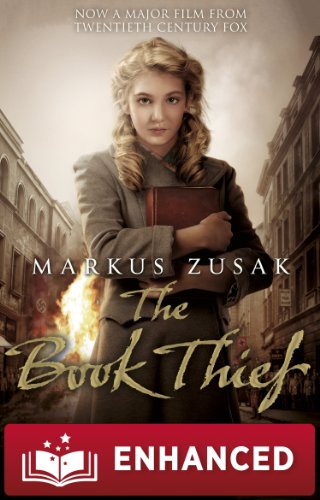
The Book Thief 
Marcus Suzak, 2008


First the colours.
then the humans.
That's usually how I see things.
Or at least, how i try.

The Book Thief, introduction

Students can read online here


The Book Thief 
Marcus Suzak, 2008

The Book Thief is a novel by Australian author Markus Zusak. First published in 2005, the book won different awards.

"1939. Nazi Germany. The country is holding its breath. Death has never been busier.

Liesel, a nine-year-old girl, is living with a foster family on Himmel Street. Her parents have been taken away to a concentration camp. Liesel steals books. This is her story and the story of the inhabitants of her street when the bombs begin to fall."


The Book Thief 
Marcus Suzak, 2008


The Book Thief 
Marcus Suzak, 2008


  • Synopsis:

Liesel Meminger is a Book Thief, living with a foster family in Germany during World War Two. Torn from everything she's known, her foster father shows her the power of words as the two of them share late night reading sessions of The Grave Digger's Handbook. Her love of books ties her to others, including the mayor's wife and Max, the Jew the family hides in the basement.


The Book Thief
Brian Percival, 2013


  • The film:

Based on the bestselling book, the movie The Book Thief tells the inspirational story of a spirited and courageous young girl who transforms the lives of everyone around her when she is sent to live with a new family in World War II Germany. Listen the young actress talking about words on the video below:


Go to the movies with your students before or after reading the book in your lessons.

On this website The Book Thief you have some guides that you can use to support the discussion in the classroom.


The Book Thief
Brian Percival, 2013

  • Some thoughts:

Of course, I am writing all the time about books and films in School Education. I love books and I'm a huge addict on movies based on books.

Movies can offer students a nice motivating push to read books. A narration lets us know something. It tells us what happened. It tells us a story. Our students love to hear narrations and watch films based on books they read in school or at home.

Many literature classics for kids and adolescents have been made into movies. Movies as The Hobbit based on J.R.R. Tolkien's novel or Hunger Games based on The Hunger Games trilogy is a series of young adult science fiction adventure novels by Suzanne Collins. And many other. 

The beautiful scene about a dictionary on the wall can not be forgotten:


Films give the chance to teach and learn Literature in a complete different way. The final result is always the best! And the list is enormous!

"Movies present language in a way that is often more natural than that found in course-books, the fantastic visual context aids understanding and boosts listening, and students just simply love them."

Steve Louw

Movies based on children and youth Literature books are an attractive and enjoyable digital resource to motivate students reading in the school.


The Book Thief 
Marcus Suzak, audio video e-book 


The e-book:

Bestseller and with a major global film release in 2014, this e-book (audio video) is enhanced with film clips and interviews with the actors from the movie as well as a Q&A with the author - a must for book lovers and movie goers alike.

Read this book or e-book and display the film in the classroom. The book and the movie are awesome. It's a life-changing story. 

I advise every teacher to check it out with your students to include the Holocaust learning theme into school curriculum.

teacher’s guide on how to generate a discussion on the importance of rescue, and student handouts describing individual story accompany the Book Thief which convey the values words, self-sacrifice, integrity and moral courage, offer a universal lesson on the importance of the preservation of human dignity and the protection of human rights.  

"To build a future you have to know the past."


Otto Frank, 1967

G-Souto

26.01.2014
update 29.05.2023
Copyright © 2014G-Souto'sBlog, gsouto-digitalteacher.blogspot.com®

Licença Creative Commons
Schools : The Book Thief : book, film : the Holocaust  bG-Souto is licensed under a Creative Commons Attribution-NonCommercial-NoDerivatives 4.0 International License.