Showing posts with label writing in the classroom. Show all posts

Thursday, March 21, 2013

World Poetry Day in school ! Resources


© Peter Reynolds drawing


"In celebrating World Poetry Day, UNESCO wishes also to promote the values that poetry conveys, for poetry is a journey – not in a dream world, but often close to individual emotions, aspirations and hopes. Poetry gives form to the dreams of peoples and expresses their spirituality in the strongest terms-- it emboldens all of us also to change the world."

Irina Bokova, Former Director-General of UNESCO

Every year on 21 March, UNESCO celebrates the World Poetry Day. A decision to proclaim 21 March as "World Poetry Day" was adopted during the UNESCO’s 30th session held in Paris in 1999.

The aim is to promote the reading, writing and teaching of poetry:

According to UNESCO: 'World Poetry Day is an invitation to reflect on the power of language and the full development of each person’s creative abilities'.
So, Poetry Day means to support poetry, return to the oral tradition of poetry recitals, promote teaching poetry, restore a dialogue between poetry and the other arts such as theatre, dance, music, painting and so on, support small publishers and create an attractive image of poetry in the media so that the art of poetry will no longer be considered an outdated form of art but one.


credits: The Stick Guy


Education:


World Poetry Day is an opportunity for children to be introduced to poetry in at school (all levels). It is a time when classrooms are busy with lessons related to poetry, in which students examine poets and learn about different types of poetry. 

Students love poetry! 

I would like to celebrate on this day the Portuguese poetry for chidren and youth. So I suggest two books from the Portuguese poet Manuel António Pina who died last October, 2012.

Manuel António Pina, awarded with the famous Prémio Camões 2011. He didn't wrote only for youth. Manuel A. Pina is one of most important Portuguese poets. His books are translated in Spanish, Danish and Bulgarian.


O Pássaro da Cabeça& mais versos para crianças

Children's poetry | Primary Education
Manuel A. Pina
illustrations: Ilda David
credits: Assírio & Alvim


Todas as Palavras/ Poetry
Youth poetry | Secondary Education

Manuel A. Pina
illustrations: Ilda David
credits: Assírio & Alvim


If you are a teacher who teaches Portuguese language and literature in Portugal or foreign countries, you may like to promote Manuel António Pina poetry in your lessons in "World Poetry Day 2013".

There are other poets present on this blog: Fernando Pessoa at Google doodle celebrates Fernando Pessoa or Jorge Luis Borges at Google doodle celebrates Jorge Luis Borges.


credits: unknown


Some Activities:

  • Encourage your students to read and write their own poetry in the classroom. For some ideas, please read my post: It's About Twiter and Poetry (World Poetry Day 2011);
  • Award your students for best and creative poems! Students love 'awards'!
  • Invite to learn from the proverbs of your country, and discover the poetic teachings of others;
  • Read up about riddles, limericks and sonnets with students to liven up your school libraries;
  • Promote a contest of poetry between different classes at you school or other schools;
  • Share some little Portuguese poems written by my students here or here (the blog is for my students in Portuguese Language curriculum): students read some traditional Portuguese riddles as inspiration for their creative written;
  • Invite a young poet to talk about his poetry with your students at school;
  • Go on the city, at book stores, metro stations, gardens, and inspire your students to read some poetry. Remember Let's Play Music! (World Music Day 2012);
  • Promote some exhibitions and poetry events in your school to be held to showcase the work of various 'young poets' (school  students) on or around March 21 to coincide more or less with "World Poetry Day";
  • Support Poetry by inviting your students and their parents buying books of young poets (sometimes, parents ask teachers for some advices about books for their children);
  • Support poetry on school radio, in school journals and display videos about poets! Bright Star by Jane Campion is a lovely film about poetry and John Keats' poetry;
  • Finally, if you have decided to introduce the Portuguese poet Manuel António Pina, you can display in the classroom as a motivation the video tribute to the poet (Portuguese language as mother tongue or foreign language).


All the activities must be adapted to the levels you are teaching : Primary education to Secondary and Vocational Education.


"Poetry is one of the purest expressions of linguistic freedom. It is a component of the identity of peoples and it embodies the creative energy of culture, for it can be continuously renewed".
Irina Bokova, Former Director-General of UNESCO


G-Souto

21.03.2013

Copyright © 2013G-Souto'sBlog, gsouto-digitalteacher.blogspot.com®

Licença Creative Commons

Thursday, January 24, 2013

Schools : Teaching the Holocaust : book & other resources

"The history of the genocide perpetrated during the Second World War does not belong to the past only. It is a ‘living history’ that concerns us all, regardless of our background, culture, or religion. Othergenocides have occurred after the Holocaust, on several continents. How can we draw better lessons from the past?"

Irina Bokova, Director-General of UNESCO


Every year around 27 January, since 2005, UNESCO pays tribute to the memory of the victims of the Holocaust. This date marks the anniversary of the liberation of the Nazi German Concentration and Extermination Camp of Auschwitz-Birkenau by the Soviet troops in 1945.  

In 2013, the theme chosen by the United Nations for this International Day is:

“The Courage to Care: Rescue during the Holocaust”. 

It highlights the exceptional actions of individuals or groups that contrast to an indifferent majority. They took action despite tremendous danger. These stories of rescue are rare but provide strong evidence that action is always possible in the face of injustice and gross violations of human rights.


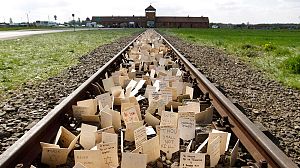
Auschwitz camp
credits: Euronews 2012

The week’s events, began on 21 January 2013, provoking each participant’s own thoughts and beliefs about the moral values and courage that lie behind such daring acts of rescue. 

Each person who becomes aware of this history will no doubt reflect upon his or her own capacity to turn compassion for others into decisive and heroic action in their time of need.


Auschwitz Museum
photo: Children portraits

Before the ceremony, UNESCO organizes a conference entitled "From Holocaust Education to the Prevention of Genocide: What have we learnt from the Past?" in partnership with the Office of the United Nations Special Adviser for the Prevention of Genocide. 

The event will include the participation of UN Special Envoy Assistant Secretary-General Adama Dieng and of several Holocaust and genocide scholars. 


Anne Frank timeline | Anne Frank House

Education:


"Freedom, goodness, giving, courage, happiness, humanity, usefulness…"

Anne Frank

Learning about this universal history can engage students in a critical reflection about the shared heritage of humanity, the roots of genocide, and the necessity to nurture peace and human rights to prevent such atrocities in the future.  


To mark International Holocaust Remembrance Day (27 January 2013), UNESCO has published a new brochure, “Why teach about the Holocaust?” which provides an overview of Holocaust education. 

The brochure explains that:
  • The Holocaust was a defining historical moment; 
  • Genocide is not inevitable; 
  • States and citizens have responsibilities; 
  • Silence contributes to oppression;
  • Prejudice and racism have roots. 
In addition, it explores the challenges and opportunities of teaching about the Holocaust and provides educational resources on the Holocaust and other genocides. 


Last year a short film entitled “Hidden Children” by renown film maker Robert Bober was shown. The film brought to light moving letters of hidden children read by French actress Anouk Grinberg. 
  • How do schools worldwide handle the Holocaust as a subject? 
  • In what areas of the world does the Holocaust form part of classroom teaching?
Answers to these questions will be provided in late 2013 by a project conducted by UNESCO and the Georg Eckert Institute for International Textbook Research.

For the first time it will be possible to compare representations of the Holocaust in school textbooks and national curricula. 
Holocaust Education exemplifies UNESCO’s vision of education as the starting point for building peace and nurturing the principles of dignity, equality and mutual respect of all men and women.


Why Teach the Holocaust, Brochure 2013
credits: UNESCO


Teachers:

UNESCO "Why Teach the Holocaust", Brochure 2013 can be downloaded here .

Resources for Teaching the Holocaust And Other Genocides here

Anne Frank official website (Netherlands) has projects and activities that you can use at school, no matter the curriculum. Students can be involved in cross-curricula. 

Visit Education to inspire you and adapt the best resources to the level you teach.

Activities: Reading & Writing

It somehow surprises me that there are so many kids who don't know anything about the Holocaust or World War II or Anne Frank.  I don't know why, but I just assumed that they were a part of everyone's school experience, and as a teacher, I am always dismayed when I discover yet again that the students are not informed about this aspect of very recent world history. 


Thus, in 2012, a survey showed that a fifth of young Germans do not even knew Auschwitz was a Nazi death camp.


Diary of Anne Frank (manuscrit)

Tuesday, 7 March 1944

Think of all the beauty in yourself and in everything around you and be happy.

Anne Frank

Literature and Languages curriculum is the perfect curriculum. We can talk, read, write, and learn about every subject.

Reading and writing are two important skills that students must handle easily and digital literacy as well.

Diaries are an interesting part of the Narrative text. Students love to read diaries written from other young people.

How do diaries help us teach about this special narrative text ? 


The Diary of Anne Frank


The Diary of Anne Frank is at once exceedingly special and totally normal. Her circumstances, her writing skill, and her insight make the diary extraordinary. 

What is it about diaries that make them such rich resources? Diarists are among the most honest writers you'll ever know!  Very few lies exist in a diary that carries the expectation of being private forever. 

Also, diaries are written in a way that is characteristic of an era.  One can learn about speech patterns, syntax, and changes in language from reading diaries.


Diário de Anne Frank


Activities:

The Diary of Anne Frank is part of my lessons when I teach the Narrative text.

Anne's diary should not be taught without context. Students must understand the circumstances surrounding the Franks' decision to go into hiding.

So, invite your students  to do a research on the official website of Anne Frank (in the classroom and at home); Anne Frank House (Facebook up-to 13), to understand better all the events during the World War IItaking some notes to discuss in the classroom. 

Of course, you must prepare carefully your lessons, choosing the best resources for the level you are teaching, reviewing in detail each one.


Anne Frank
via Wikipedia

Students love to read The Diary of Anne Frank, they discuss a lot about Anne's ideas shared on her diary. You can read (Portuguese language) some thoughts of my students on the Dia Internacional da Memória do Holocausto (blog of my students in Portuguese language).

She inspires them to write touching creative texts: pages of a diary; letters to Anne; storytelling; poetry. 

They always ask for other suggestions about books on the same or similar subject.

Note: If you're going to use the diary as a reading book, try to fit in the whole thing. 

Resources: Films

  • Elementary education (up-to 8-13 years)
Anne Frank The Whole Story,  Robert Dornhelm (2009) 

The Boy in the Striped Pyjamas (2009) based on the book by John Boyne

  • High Junior School | Secondary Education
Schindler's List, Steven Spielberg (1993)

Sophie's ChoiceAlan J. Pakula (1983) based on the book by William Styron

Aristides de Sousa Mendes, O Cônsul de Bordéus (2011), a true story of rescue, (English subtitles).


  • App "The Diary of a Young Girl" by Anne Frank: ipad (all levels)


To coincide with "Holocaust Memorial Day", Penguin Books launched an app of The Diary of a Young Girl by Anne Frank available on iTunes
The app has a wealth of embedded content: video footage of Frank's only living relative Buddy Elias, audio extracts of the diary read by Helena Bonham Carter and translated facsimile pages from the original diary. There are also "Story Trails" with titles such as "Fear" and "Life in Hiding".


iPad screenshot | Anne Frank app
https://itunes.apple.com/nz/app/anne-frank/


ipad screenshot | Anne Frank app
The diary has been translated into dozens of languages, is read by millions of people and is on the curriculum of so many schools around the world.

Anne Frank’s diary has inspired children’s authors to write books that continue the importance of telling the stories. There are some good books for young people that we can include in the curriculum.

Language: English

Price: $9.99


Other Resources:

  • Books (e-books) | Authors - Literature & ICT
The Diary of Anne Frank by Anne Frank  (students blog)

The Book Thief by Markus Zusak (on this blog)

The Boy in the Striped Pyjamas by John Boyne (students blog)


O Mundo em que vivi by Ilse Losa (German-Portuguese children's writer) 

Let Me Whisper You My Story by Moya Simons

Trilogy Then | Once ! Now by Morris Glietzman

The Reader by Stephen Daldry


  • BD | Manga


Anne Frank au pays du manga
Alain Lewkowicz 


Anne Frank au pays du manga est une BD documentaire interactive. Un voyage en BD documentaire interactive "pour comprendre ce qui, de la Shoah et d'Hiroshima, peut - ou non - constituer une expérience commune au Japon et à l'Europe."

  • Web | Social media

Anne Frank official website 
http://www.annefrank.org/en/

Anne Frank House | Facebook
https://www.facebook.com/annefrankhouse

Official Anne Frank Channel | YouTube
http://www.youtube.com/annefrank

Ilse Losa: uma escritora luso-alemã
http://fragmentosvirtuaisdumaprofessora.blogspot.pt/2012/11/ilse-losa-1913-2006.html

The Anne Frank Center US
http://annefrank.com/

USC Shoah Foundation | Teacher Education
http://sfi.usc.edu/education/

The Insurbodinate Consul of Portugal
 http://www1.yadvashem.org/yv/en/righteous/stories/mendes.asp

Sousa Mendes Foundation, vidéo (French language, English subtitles)
http://sousamendesfoundation.org/filmvideo/

Aristides de Sousa Mendes, O Cônsul de Bordéus (2011) Portuguese language, English subtitles 
http://www.trailers.com.pt/o-consul-de-bordeus/

Sousa Mendes saved more lives than Schindler | The Independent
http://www.independent.co.uk/news/people/profiles/sousa-mendes-saved-more-lives-than-schindler-so-why-isnt-he-a-household-name-too-2105882.html


I'm sure you will develop wonderful projects with your students. They love History  and Literature. Love biographies of other young people.

You don't have to finish in a week. Give some time of your lessons to really help your students to understand the values of a young girl who died tragically but never lost her faith in a better world.


"Transmitting the memory of the Holocaust is a vital part of the struggle to combat ignorance and prejudice through education in humanist values, the sharing of cultures and knowledge of history.”

Irina Bokova, Director-General of UNESCO

G-Souto

24.01.2013
update 27.2013
copyright © 2013G-Souto'sBlog, gsouto-digitalteacher.blogspot.com

Licença Creative Commons
Schools : Teaching the Holocaust : book & other resources bG-Souto is licensed under a Creative Commons Attribution-NonCommercial-ShareAlike 3.0 Unported License.

Wednesday, June 8, 2011

Stay Creative in Literature curriculum!


29 WAYS TO STAY CREATIVE from TO-FU on Vimeo.


Education: 

You know that I am a fan of social media in the school! Facebook, Twitter, others are interesting resources! 

So, we have here an interesting motivation video to share with our students on Facebook - 'educator' account, not 'personal' account - if they must write an essay at Literature curriculum. 

And we know that they must write and write! But in a creative way! 

Oh! Of course : tip 15 - Practice, Practice, Practice!


G-Souto
08.06.2011
Copyright © 2010G-Souto'sBlog, gsouto-digitalteacher.blogspot.com®

Credits: Motion Graphics TO-FU
Reference: paulzii.tumblr.com
Music: Fairest of them all (#) by Kämmerer


Licença Creative Commons
Stay Creative in Literature curriculum by G-Souto is licensed under a Creative Commons Attribution-NonCommercial-ShareAlike 3.0 Unported License.