Showing posts with label activities for middle and secondary education. Show all posts

Sunday, November 10, 2013

Schools: World Science Day for Peace and Development 2013


Poster WSDPD

Today, in a world changing quickly, on a planet under pressure, we need more science, we need more scientists. Science is a force that brings people together, to join hands in the pursuit of knowledge. Science is our best ally to tackle the consequences of climate change, to foster the innovation all societies need today." 

Irina Bokova, Director-General of UNESCO


World Science Day for Peace and Development, celebrated each year on 10 November, offers an opportunity to demonstrate how science is relevant to our daily lives and to engage the scientific community, policy makers and the public. 

The World Science Day for Peace and Development also aims at raising public awareness of the importance of science and to bridge the gap between science and societies.


This year’s theme, "Science for Water Cooperation: Sharing Data, Knowledge and Innovations, highlights the key role played by Science, Technology and Innovation (STI) in addressing global water challenges."

"Water resources pay no heed to borders–our cooperation must be guided by the spirit of solidarity. Together, we can harness the full power of water to strengthen human dignity and build a better future for all. This is UNESCO’s message today."


It's with joy as Portuguese specialist in Education to know that the Director-General of UNESCO, Irina Bokova and the Portuguese Minister of Education, Higher Education and Science, Nuno Crato, signed yesterday, on 9 November 2013 an Agreement for the Establishment of an International Centre for Advanced Training of Scientists from Portuguese-Speaking Countries in the Areas of Basic Sciences under the auspices of UNESCO.


Education:

UNESCO invites schools, teachers and students among the different organizations to celebrate the Day with some special events or action.

We know! Today is Sunday. No school time.  But tomorrow and for a week or two, you can motivate your students (they love to engage in Environment causes) by involving them at the WSDPD activities. 

After all, the day is a symbolic. Of course, students need different lessons to organize an event and develop some activities.


Levels: All levels (different activities for different grades and age)

Here some activities and resources that can mobilize support for the objectives of the World Science Day for Peace and Development 2013:


Activities:

I selected and adapted some of the actions proposed by UNESCO that I think might involve our students:


  • Diffuse the WSDPD in your school through posters, flyers (made by students);
  • Distribute the WSDPD's poster to schools (based on material downloaded from website); scientific institutions, local communities;
  • Organize classroom discussions to emphasize the many different ways science and technology touch our daily lives;
  • Incorporate the messages of WSDPD into your classes, school librarian, and other activities taking place on a week;
  • Ask students to write articles and letters about the importance of science for sustainable societies to the media, including school newspapers.
  • Organise an 'Open Day' in your school to highlight the importance of science for peace and development;
  • Contact national and local media (TV, radio, print, electronic) to highlight the importance of celebrating WSDPD at your school;.
  • Invite an expert to visit your school to speak about careers in science, deliver scientific presentations or demonstrations to young students;
  • Build classroom-to-classroom connections between schools via the Internet ( email, hangout, Skype), Twitter, Facebook, Google to talk about science projects that will interest young people;
  • Find a sister institution (same country or other country as an exchange project) and and carry out a joint activity highlighting the importance of science;
  • Arrange a science museum visit in your city or another local city;
  • Invite local university faculty to join with community organizations and schools to celebrate the Day.

The sucess of  WSDPD is on the hands of the active involvement of many partners (intergovernemnental, non-governemnental organizations), academic institutions such as science and research.  

Schools are in this list, for sure. Schools have an important role aiming to renew and reinvigorate global commitments as they have the mission to educate children and young people as the future citizens.


Goccia, the official mascot of WWD2013

Educational Digital Resources:

On the website of the International Year of Water Cooperation 2013 there is the Youth and Kids section where you will find exciting resources and educational materials for educators, youth and kids, including games, publications, tools and videos.

Goccia, the official mascot of World Water Day 2013 and the International Year of Water Cooperation will guide you through the Youth and Kids section to learn about our water resources and the way they are used on the planet. 
  • Games
  • Publications and Educational Tools
  • Videos
Oh! Talking about educational resources, don't forget, Apps for Environmental Education! Zoe makes a splash! Remember?


10 Years UN Water (2003-2013)


Campaign Materials:

The UN Water page will be providing you 'campaign materials' to help create a buzz about the International Year of Water Cooperation and also World Water Day 2013

Check this space often because we will keep producing fun stuff before and throughout 2013. Soon you will also find material to help you learn more about Water Cooperation

After Water Water Day 2013 (March), Earth Day 2013 (April), Going Pink at School (October), we have World Science Day for Peace and Development 2013.


These series of educational challenges are important to promote some good values in the new generations. They will be vigilant and helping to find path towards precious solutions to society and planet.


Of course the sucess of  WSDPD is on the hands of the active involvement of many partners (intergovernemnental, non-governemnental organizations), academic institutions such as science and research.  

Schools are in this list, for sure. Schools have an important role aiming to renew and reinvigorate global commitments as they have the mission to educate children and young people as the future citizens.


I hope this post will be inspirational for a lot of educators in the world.

"Nothing will happen without action. Create and follow a plan, you're going to get a result. It may not be perfect but at least you have started."

Bob Proctor


G-Souto


10.11.2013
Copyright © 2013G-Souto'sBlog, gsouto-digitalteacher.blogspot.com®

Licença Creative Commons
Schools: World Science Day for Peace and Development 2013 bG-Souto is licensed under a Creative Commons Attribution-NonCommercial-ShareAlike 3.0 Unported License.

Friday, September 20, 2013

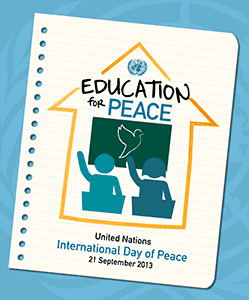
Education for Peace: International Day of Peace


Credits: UNESCO

"On this International Day of Peace, let us pledge to teach our children the value of tolerance and mutual respect.  Let us invest in the schools and teachers that will build a fair and inclusive world that embraces diversity.  Let us fight for peace and defend it with all our might."
UN Secretary-General Ban Ki-moon 
International Day of Peace is celebrated on 21 September every year. This year, 2013 idevoted to peace education.

The International Day of Peace was established in 1981 by resolution 36/67PDF document of the United Nations General Assembly to coincide with its opening session, which was held annually on the third Tuesday of September. 

The first Peace Day was observed in September 1982. Since wars begin in the minds of women and men, it in the minds of women and men that the defences of peace must be constructed. 

"Education is the foundation of any lasting peace. It is the driving force behind freedom and tolerance. It stems the tide of ignorance and mutual misunderstanding, the means by which disagreements all too often degenerate into violence. Education fosters the culture of dialogue that is necessary to resolve conflicts."

Irina Bokova, message


Credits: UN

UNESCO campaigns for quality education for all going further than the basics of reading and writing. 


Education must encompass the teaching of human rights, living together and respect for others

Peace education is one of its key components. Every child in the world should know their rights, and learn their own history and that of other peoples, so as to be able to understand the equal dignity of cultures and draw lessons from the crimes and violence of the past.

The key to tolerant citizenship in a globalized world requires a widespread effort to train teachers and design suitable school curricula. 

These principles inspire UNESCO’s work, in particular through the International Decade for the Rapprochement of Cultures (2013-2022), adopted by UNESCO’s General Conference and the United Nations General Assembly.


Credits: Peter H. Reynolds


Education:


Of course celebrating International Day of Peace is only a start to motivate students to practice a peace behaviour in the school and along adult life. So, we can develop this theme every moment of the curriculum we teach.


There's a new young generation of peace minds, believe me!

Ideas for activities with your students:

1. Designate a webpage on the website of the school to build a digital pledge on peace education;

2. A wall in the classroom or a space in the school - school library for  example - where students from different curricula can display their depictions of peace through works of art, photos, storytellings;

3. Organize exhibits of photos or drawings or texts/poems/news about peace in school or other public spaces near the school;

4. Set up information stands on Internet, social media (radio, television) or social networks (Twitter, Facebook, Google +) to raise school awareness on the issue;

5. Ask students to search on their tablets, smartphones about human rights in your country;
6. Ask students to choose a little theater piece to perform in the school library and invite parents, teachers, the maire, and students from another school;
7. Present a film on this theme in the classroom or in the school library, and invite teachers, parents, and other students to a round table discussion;

8. Make a film (if the school have a YouTube account) joining authentic documents (photos) and texts written by students, personal testimonies of violence and publish it;
9. Ask students to prepare information brochures, flyers, pins, to distribute in your school and community.


Credits: Vision of Humanity

Impressive this video about Global Peace in 2013!

We must not forget Peace One Day movementThroughout the years, millions of people have been active on Peace Day in every country of the world, and hundreds of organisations have carried out life-saving activities in areas of conflict. Peace One Day’s Campaigns and activities in Education, Music, Film, Sport, Dance, Art and Online have proved that the day works.


If you are preparing some activities, fill out the short form here and Peace One Day will share your inspiring ideas and plans for the day with its worldwide community of supporters, and multiply the impact of your important work.

In a world in complete change, young people have a relevant voice to demonstrate their critical thinking and creative ideas about a new intercultural dialogue, interconnectedness, capacity building, in order to innovate the society and build a different world  through important values as Peace and Culture.

"We must give to future generations a culture of dialogue and build, through education, a world that is not only more connected, but also more compassionate."

Irina Bokova, message

G-Souto

20.09.2013
Copyright © 2013G-Souto'sBlog, gsouto-digitalteacher.blogspot.com®

Education for Peace Resources:

Education for Peace | UN

http://www.un.org/en/events/peaceday/2013/resources.shtml
Resources for Culture of Peace and Non-Violence | UNESCO
http://www.unesco.org/new/en/bureau-of-strategic-planning/themes/culture-of-peace-and-non-violence/selected-references/education-and-peace/

Education Resources | Peace One Day
http://peaceoneday.org/resources/

Licença Creative Commons
Education for Peace: International Day of Peace bG-Souto is licensed under a Creative Commons Attribution-NonCommercial-ShareAlike 3.0 Unported License.

Thursday, February 9, 2012

e-Safety for Kids: Trust, a film about safety on the Internet


Trust
 David Schwimmer, 2010
https://www.imdb.com/


It's Safer Internet Day 2012. This year, as you have read on my publication Make your Safer Internet Daythe theme is centered on :


"Connecting generations and educating each other"


SID 2012 encourages users, young and old, to "discover the digital world together... safely"!

"With all of the potential that the online world and new technology offers, young people now have access to huge opportunities. They use technology to express themselves, explore, and be creative; it has changed the way they communicate."


Indeed! Internet changed the way we express and the way teens communicate with friends and no friends. And that is the other side of the Internet. So, I would like to share with you a special and difficult movie about teens on the Internet.

Child exploitation on Internet is worrisome. Reports said that 70% of this kind of abuse is passing by social networks. But, on this film, the young girl and the adult met in a "teen chat room" which is typical of these type of situations. 


Chat rooms are generally considered more dangerous than social-networking sites because they encourage real-time conversations that can be easily moved to private instant-messaging venues. 


Trust
 David Schwimmer, 2010
https://www.imdb.com/


Young girls (between 12-17) as they grow up faster than boys, they love to expose themselves on the Internet, sharing everything: photos, privacy, sometimes home adress and school adress, specially when they are on teen chat room or other.

Predator' chat strategies are increasingly refined. Sometimes, parents are paying attention to their kids, but they don't 'see' how their lovely daughters are growing up so fast.


This is why, I would like to point Trust. The film was on the movies some months ago. And in France it's now o the movies.


I watched Trust (last year). The film didn't surprise me, but shocked me. I was prepared to the kind of predator but not for 'the predator' at the end.

After watching the film, I spent some time lost in my thoughts. I couldn't believe! Back to school, I discussed the movie with some teachers (men and women). Later, I discussed it with parents and their children, my students (up to 12-15). 
I asked mysef - must I present the film on a post or not? - but finally, I could conclude that it is more important to share it with parents and other teachers, no matter how difficult the end can be.

One teen being exploited is one teen too many and if Trust can help prevent even a single teen from being emotionally or even physically harmed, then sharing the film will have been well done.

I think it is essential for parents to watch it too. Of course, it's also an important resource for teachers. By displaying the video in the classroom (high schools), teachers must introduce safety on the Internet.

Trust is about online sexual predators, a chilling cautionary tale about online sexual predators and the shattering fallout for a 14-year-old and her family.

The story centers on Annie 14 year old girl who meets a boy online who turns out to be a wolf in teenage clothing. He is actually a 35 year old pedophile who grooms the naive and gauche 14 year old, meets her and sexually abuses her. 


Annie and 'Charlie' 
Trust
 David Schwimmer, 2010 

  • Synopsis:

Annie (Liana Liberato), from a middle-class Chicago suburb, is a shy 14-year-old who strikes up an increasingly intimate online friendship with "Charlie"(Chris Henry Coffey), who claims he is 16, later on admitting to being in his mid-20s. By the time he flies in for an assignation with her in her hometown, we (unlike Annie) are not shocked to discover that he’s in his mid-30s. He takes her back to his hotel room and sweet talks the terrified but mesmerized girl into bed. (Mercifully, the scene fades out without showing anything explicit.)


Annie and her mother 
Trust
 David Schwimmer, 2010 

Annie’s parents, Will (Clive Owen) and Lynn (Catherine Keener), are portrayed conventional types. When they discover what has happened to Annie, their coziness is shattered. Rape charges are filed (Annie, in deep denial, at first denies she was raped because she is in love) and the FBI conducts a manhunt for "Charlie," who has a long list of previous victims.


  • Important Information: parents

The film is based on data from the Crimes Against Children Research Center (CACRC), but the facts on it are fictional.


Trust
 David Schwimmer, 2010 

  • Some important messages for kids, parents and teachers:

Parents, wake up! If your teenager spends hours glued to their phone or buried in their rooms online on a laptop or PC, chatting or doing nothing, then you have to watch Trust.  Because instead of just shrugging, or smiling to yourself that you know where your kids are and what they are doing, this film will show you just how at risk they really are.

Kids and young adolescents do need to be reminded that not everyone they meet online is who they say they are. As parents, you might wonder whether what they are doing is safe. 

As parents, you might also be thinking how can you be as good a parent online as you are offline

Parents need to understand that it's important to stay in close touch with their kids' online use. Dialogue is very important, but it is not enough. 


Trust
 David Schwimmer, 2010 

  • Teens :
The story centres on Annie 14 year old girl who meets a boy online who turns out to be a wolf in teenage clothing.  He is actually a 35 year old pedophile who grooms the naive and gauche 14 year old, meets her and sexually abuses her.  But she denied that, she is in love with 'Charlie' and she suffers a lot when he goes away.

Even kids and adolescents like to be independent, they must have the skills since the younger age, for the safe use of Internet. So, at home, in school, they must be alerted and taught how important it is to their safety. 

Safer Internet Day is an good start for parents and teachers to sit together with children or students and discuss those important issues. 

As students participating in the different activities for Safer Internet Day, they are learning about dangers and they are developing the skills  to keep themselves safe when they are online.


Trust
 David Schwimmer, 2010 

  • Parents:

The film shows how it is done, how easily it is done, and then the fall-out from what happens. Parents are completely lost.
"Abuse has a terrible impact on children, and on whole families, whether perpetrated from within or outside their nest: at times, you will be watching through your fingers."
We also need to understand that the internet is simply a place.  Somewhere your kids go to hang out.  And if they were doing that physically, you would want to know where they were going and who they were going with.  
Parents need to start asking the same kind of questions, when their teenagers are online, ignoring the one word 'nowhere' or 'no-one answers'.
Because just as when they head out the door, every time they go onto an online space there are potential risks.  And while you cannot be there with them, you should at least attempt to satisfy yourself you know where they are going and with whom.
Trust conveys, at its best, is that ultimately parental protections are not full proof, and that is the greatest horror of all.


Trust
 David Schwimmer, 2010 

  • Social message:
The film also shows how pervasive technology can be in teens lives and also how sexualised the society has become. And this is the hard bit for parents! Parents can also benefit by watching how Annie's dad evolves during the film. 
 
đŸ‘‰My thoughts: teachers and parents


Teachers help students to understand the safe use of Internet in the school, it's a fact! But parents must pay attention at home and help too. Absolutely.
Children grow and become more independent, it is only natural that they take this independence online. 
Parents and teachers have to install in our young people an ability to keep themselves safe. Resilience had gone out of fashion in child care lingo but actually it is vital. 

Most kindergarten and preschool curricula do not include lessons on new technologies, but they should. Including concepts of modern communication through new technologies and social networks in daily vocabulary and activities is essential. 

The participation of kids and young adolescents at Safer Internet Day is a very important activity to include safety on internet into school curricula and family activities.
If you and your kids or students watch the movie, use it as a discussion starter, and remember, your 'kids are probably all right'. 


*Note: The film shows disturbing material involving the rape of a teen, language, sexual content, and some violence. 

But nothing that you can not overtake as parents or teachers if you use an open discussion. 

Watch David Schwimmer talking about his film Trust, which captures the havoc wreaked upon a suburban American family when a teenage girl is groomed for sex by an online predator:


đŸ‘‰Some thoughts:


"We just want people to engage more in being a more present parent." said David Schwimmer, Trust director. The key message is communication.

We cannot always protect our children, including the ones we don’t know, and we need to give them the skills to keep themselves safe. Knowing how to sniff out trouble, knowing how to avoid it, and knowing how to handle it when it comes knocking are key essential life skills.

Please search for latest information on websites your kids like to visit, mobiles and new technology. Find out what’s good, what’s not and what they can do about it. 

There are always areas on websites about safety if you look after young people, with resources that teachers and parents can use at home,  at school or just to get with it. 
Most importantly, there’s also a place which anyone can use to report if they feel uncomfortable or worried about someone they are chatting to online.

Crimes Against Children Research Center (CACRC), Child Exploitation and Online Protection Center (CEOP) are developing software that tracks the Web's evolving child pornography lexicon as well as predators' chat strategies to help law-enforcement agencies catch the most secretive of these criminals before they strike.

"The Internet is positive for children – not just for online education, but as a place to socialise, play and create. But whether they're doing it for work or play, they must be able to do it safely, to forge positive relationships and cope with online risks."

Neelie Krois
Former Vice-President of the European Commission
Responsible for the Digital Agenda

Is there an Internet active young person in your life, that you care about? Trust should probably be on its list of movies to see.


G-Souto

09.02.2012

update 17.08.2026
Copyright © 2012G-Souto'sBlog, gsouto-digitalteacher.blogspot.com®

Licença Creative Commons
e-Safety for Kids : Trust, a film about safety on the Internet by G-Souto is licensed under a Creative Commons Attribution-NonCommercial-ShareAlike 3.0 Unported License.

Credits: video ThinkUKnow | Australia


References | Resources for parents and teachers :

Insafe (Europe)

Tips for families

Internet sans Crainte (France)
https://www.internetsanscrainte.fr/


Internet Segura (Portugal)