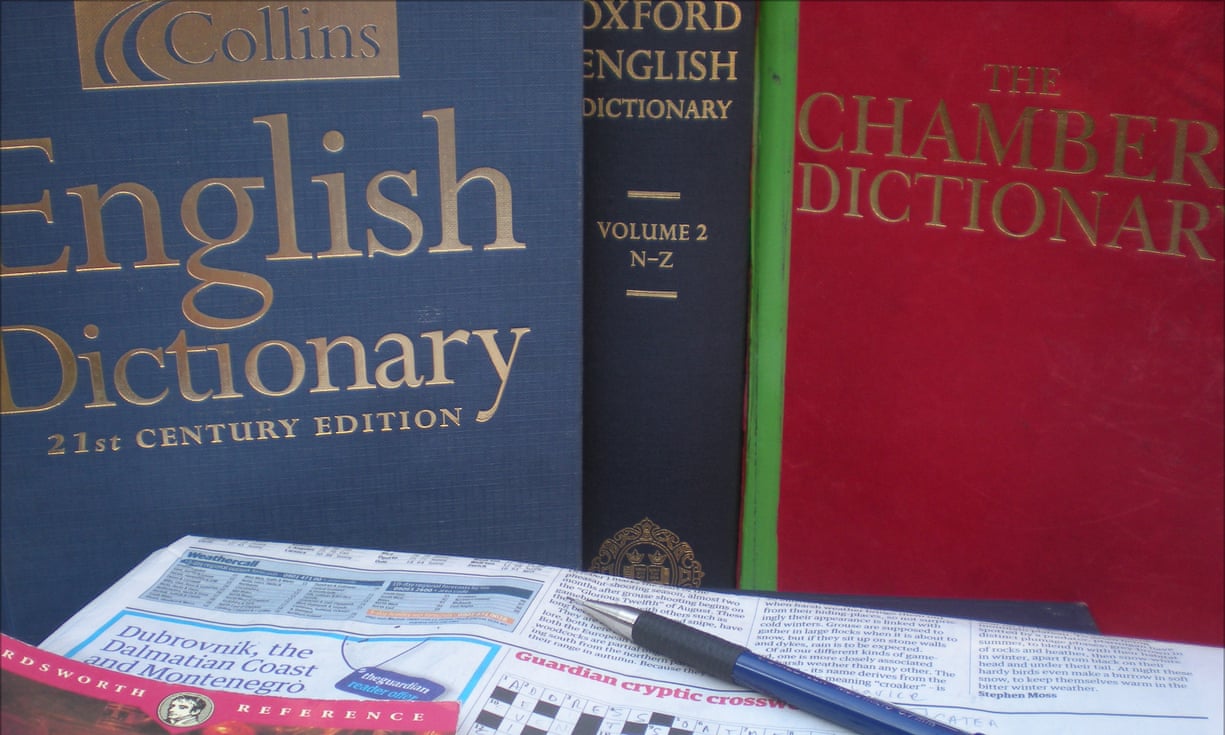
Oxford English Dictionary
The Oxford English Dictionary (OED) is the accepted authority on the English language, providing an unsurpassed "guide to the meaning, history, and pronunciation of more than 280,000 entries – past and present – from across the English-speaking world."
As a historical dictionary, the OED is very different from Dictionaries of current English, in which the focus is on present-day meanings.
We'll still find present-day meanings in the OED, but we’ll also find the history of individual words, and of the language—traced through 3 million quotations, from classic literature and specialist periodicals to film scripts and cookery books.

The OED started life more than 150 years ago. Today, the dictionary is in the process of its first major revision.
Updates revise and extend the OED at regular intervals, each time subtly adjusting our image of the English language. The last one in June 2017, another one in March 2017.

What's New?
More than 600 new words, phrases, and senses have been added to the Oxford English Dictionary in June 2017 including bug chaser, chantoosie, gin daisy, and widdly.

You can read about other new and revised meanings in the article by Katherine Connor Martin, Head of US Dictionaries, and explore OED timeline of veil words.
As this update also includes revisions to the word come, Denny Hilton, Senior Editor of the OED, explores the evolution of the term to come out in release notes.
You can also review your serve - or your backhand or volley - in OED discussion of tennis terms.
You can also review your serve - or your backhand or volley - in OED discussion of tennis terms.
Selected Letters of Norman Mailer (2014, edited by J. Michael Lennon) has recently been read as part of the OED’s reading programme, and the letters have provided several antedatings and some interesting insights into the challenges of finding evidence for swear words in the nineteenth and early twentieth century. You can read about this here.
*Don't forget to explore my post English Dictionaries Oxford & Collins (January 2017.
*Don't forget to explore my post English Dictionaries Oxford & Collins (January 2017.

When work began on the Philological Society’s proposed new English dictionary in the 1850s, the modern game of tennis did not exist. At that time, ‘tennis’ referred to what we now know as real tennis or (in North America) court tennis, a ball game of French origin played since medieval times on a purpose-built roofed oblong court.

This game had made its own impression on the English language and its literature: perhaps most famously, Henry V, in a scene immortalized by Shakespeare, is said:
And tell the pleasant Prince this mock of his
Hath turned his balls to gunstones, and his soul
Shall stand sore chargèd for the wasteful vengeance
That shall fly from them….


Henry V
William Shakespeare
This game had made its own impression on the English language and its literature: perhaps most famously, Henry V, in a scene immortalized by Shakespeare, is said:
And tell the pleasant Prince this mock of his
Hath turned his balls to gunstones, and his soul
Shall stand sore chargèd for the wasteful vengeance
That shall fly from them….
Act I, scene ii, Henry V
In the throne room of the royal palace in England, King Henry V prepares to speak with a delegation of ambassadors from France, after have received a mocking ‘gift’ of tennis balls from the Dauphin of France with the suggestion that playing tennis was a more suitable occupation for him than making war. Henry did not take this well.
Most of the tennis-related items that have now been added to Oxford English Dictionary Online reflect the changes and developments in the game in the twentieth century, of which the most important is professionalization.
Some other entries 2017:
Some other entries 2017:

Kodak moment
Some of them seem to be rather late additions - Kodak moment and sausage party - but others might become part of your daily lexicon.

They include zyzzyva, a genus of tropical weevils native to South America. The word replaces zythum - an ancient Egyptian malt beer - as the OED's final entry.

Zyzzyva
Zyzzyva is a genus of tropical weevils often found in palm trees in South America. According to the OED, the word should be pronounced Ziziva.
The word, which will now become the final listed among the 826,000 entries in the English language according to the OED, has previously appeared in a number of other dictionaries and will now finally receive recognition.

Yas
And other new words have been added, including cringey, bronde and yas.

Aquafaba, n.
Culinary:
The culinary world always serves up a feast of new terminology, and the latest spread is no disappointment. The new menu ranges from the healthy - such as superfruit, a term used to refer to fruits considered to be particularly beneficial—to the markedly less healthy - such as shoestring fries, also known as shoestring potatoes, which are French fries sliced extremely thinly. If you order the Cuban sandwich frita (from the feminine of Spanish frito meaning ‘fried’), you’ll find a handful of these fries in addition to seasoned pork and beef. Should you require something a little more vegan, perhaps you’ll be tempted by aquafaba, a substitute for egg whites used in vegan cooking, with a name that translates from Latin to ‘water-bean’. This name is a reference to the substance’s origins as the water in which chickpeas, or other pulses, have been cooked. Other words

4Freecycle, n.
The Environment:
With certain foods (such as courgettes) becoming less available in the UK due to poor crops, the environment has been on everyone’s mind here, though likely it weighs heavier on the minds of climate refugees—this term refers to those forced to leave their home due to the effects of climate change rendering it unsafe or uninhabitable. More words

Flyboarding, n.
Sports:
One of the latest water sports that’s defined by our online dictionary is flyboarding, in which a person travels through the air—in an act that looks suspiciously like flying—using a board propelled by jets of water. Granted, the flyboard is attached to a jet ski, but this is a good-sized step closer to the forms of transport I’ve always expected the 21st century to offer us.

To skitch, v.
Thrill-seekers on the hunt for a way of levelling up their commute might choose to skitch: this word is a blend of skate or ski and hitch, and refers to the activity of ‘hitching’ onto a motor vehicle while riding a bike, skateboard, etc. so as to travel at greater speeds, not always giving the driver any warning of your intentions. Possibly not the safest way... More words


Other new entries:

Meet-cute, n.
meet-cute (noun):(in a film or television programme) an amusing or charming first encounter between two characters that leads to the development of a romantic relationship between them.
In romantic comedies and Disney movies, the protagonists tend to meet in the most adorable of ways.

Hackfest, n.
Hackfest, noun: an event dedicated to sharing information about computer programming. Make sure you’ve understood the invite though, because hackfest can also refer to a period of frenzied violence. In this sense, it differs…

web tablet
http://images.pcworld.com/
web tablet, noun: new computing tool. With the introduction of the iPhone in 2007, and the iPad in 2010 now both used in the classroom, education began to change. For good!
Scratch, noun: a free programming language and online community where students can create their own interactive stories, games, and animations.


Eminem, rapper
credits: Christopher Polk/ AFP
Well, it's a long list! See a full list of new words, subentries, and senses added in this update.

- Resources:
- New feature: Interactive surfing timeline
- Explore the OED interactive surfing timeline to see when surfing words entered the English language.
Resources online: Students

Education:
Young people are probably the most creative agents for new words because they’re not held back by convention, for sure.
‘Young people are the real artists of the language and a dictionary should reflect that."
David Swarbrick, managing director at Chambers, 2015
Our students suprises us every day with new words. They often are the new 'linguistics' of the XXI century.
Without young people and new technology, languages would be 'death languages'.
If so, no excuse for students! They don't appreciate to use the dictionary. But dictionaries are imperative resources to understan what they are reading or writing.
It's a vast and very useful educational tool for students, in this case OED, to learn and understand the English language, English literature, history, law, and many other subjects.
The dictionary encourages knowledge, curiosity and vocabulary skills.
Teachers can place holder sheets practices to be used by younger students according to their learning level.
There are interesting resources to practice the English language.
Be stan of a dictionary (native language and foreign languages. And don't skitch...
Note: The digital resources and educational tools published on this blog are my own free choice. I don't do endorsements or advertising.
G-Souto
16.07.2017
Copyright © 2017G-Souto'sBlog, gsouto-digitalteacher.blogspot.com®

Let's talk ! Oxford English Dictionary, new entries 2017 by G-Souto is licensed under a Creative Commons Attribution-NonCommercial-NoDerivatives 4.0 International License.
Without young people and new technology, languages would be 'death languages'.
If so, no excuse for students! They don't appreciate to use the dictionary. But dictionaries are imperative resources to understan what they are reading or writing.
Teachers can place holder sheets practices to be used by younger students according to their learning level.
Be stan of a dictionary (native language and foreign languages. And don't skitch...
Copyright © 2017G-Souto'sBlog, gsouto-digitalteacher.blogspot.com®
Let's talk ! Oxford English Dictionary, new entries 2017 by G-Souto is licensed under a Creative Commons Attribution-NonCommercial-NoDerivatives 4.0 International License.