Monday, September 12, 2016

Games in school : ABZÛ, the game under the water in the classroom


screenshot ABDÛ

ABZÛ or ABZU is a awesome underwater exploration adventure game that evokes the dream of diving.

From the art director of Journey®, ABZÛ is a beautiful underwater adventure that evokes the dream of diving, immersing ourselves in a vibrant hidden world bursting with color and life as we descend into the heart of the ocean. But must be aware as we swim deeper as dangers lurk in the depths.


screenshot: game ABDÛ
http://store.steampowered.com/


What means the word ABZÛ?

ABZÛ is a word from the oldest mythologies. AB, meaning water, and ZÛ, meaning to know. ABZÛ is the ocean of wisdom. Also refers to a Mesopotamian myth about a primeval sea.

Despite what you might imagine though this is not an open world game in the manner of Endless Ocean.

There is a lot of exploring but students proceed through essentially linear environments, from coral reefs to the ruins of a long civilisation


screenshot: game ABDÛ


Goal: 

The principal goal? To explore the underwater world and find the meaning to all its beautiful secrets. ABZÛ is a beautiful underwater adventure that evokes the dream of diving. 


Some thoughts: 

This game is visually one of the most beautiful games. Images are fantastic. And the soundtrack is incredible. 

"Fish and other creatures swim and scuttle about in a bealieable way, reacting to each other, and what seems to be their own natural instinct, creatinga awe-inspiring displays of colour and movement."

The game’s a joy to look at, listen to, and move around in. Do you want better for a science curriculum at school?


Education:

My usual readers know me! I'm always searching for new ideas and digital resources to help the integration of games in school education. 

There are so many games, apps, educational digital resources to include into your lessons, making learning fun. You will find different proposals by searching on my blog along the years.

Immerse your students in a vibrant ocean world full of mystery and bursting with color and life:
  • Performing fluid acrobatics as the Diver using graceful swimming controls.
  • Discovering hundreds of unique species based on real creatures and form a powerful connection with the abundant sea life. 
  • Interacting with schools of thousands of fish that procedurally respond to you, each other, and predators. 
  • Lingering in epic seascapes and exploring aquatic ecosystems modeled with unprecedented detail. 
  • Descending into the heart of the ocean where ancient secrets lie forgotten. 


Simple controls and enjoyable movement system are great fun to play around with. I'm sure students will love it.


screenshot: game ABDÛ


Available:

PlayStation 4 and PC

Price:

£15.99

Release Date: 

2nd August 2016

Level : 

Primary; K12; junior high-school.

Curriculum:  

Sciences; History; Technology/ Computing. 


Teachers and students will decide how explore ABDÛ in the classroom. The game opens a huge possibility as a digital resource that I advice to include into school curriculum. 


screenshot: game ABDÛ

My thoughts: 

Why not learning by having fun by playing games in school. You know how your students love to play. Games in school will offer an incredible teaching. Students will learn much better and easier.


Of course, it will be a good resource for Computing curriculum. Students will be encouraged to follow their dream to be a game designer. 


Important note:

Never include a resource into your lessons without prepare it previously. In this case, you must watch the game, app or other resource, analyze if the content is good or adapted to the age of your students, the level and the curriculum you are teaching. And prepare some good activities to propose to your students.

Remember it! This preliminary work, a good preparation, is fundamental to the success of your lessons.

G-Souto


12.09.2016
Copyright © 2016G-Souto'sBlog, gsouto-digitalteacher.blogspot.com®

Creative Commons License
Games in School : ABZÛ, the game under the water in the classroom bG-Souto is licensed under a Creative Commons Attribution-NonCommercial-NoDerivatives 4.0 International License.


Thanks to Steam

Thursday, September 8, 2016

Schools : International Literacy Day : 50th Anniversary


Reading the Past, Writing the Future


"The world has changed since 1966 – but our determination to provide every woman and man with the skills, capacities and opportunities to become everything they wish, in dignity and respect, remains as firm as ever. Literacy is a foundation to build a more sustainable future for all."

Irina Bokova, UNESCO Director-General  

Fifty years ago, UNESCO officially proclaimed 8 September International Literacy Day to actively mobilize the international community and to promote literacy as an instrument to empower individuals, communities and societies.

This year marks the 50th anniversary of International Literacy Day and UNESCO is celebrating it under the theme:

“Reading the Past, Writing the Future”. 

"International Literacy Day 2016 celebrates and honours the past five decades of national and international engagement, efforts and progress made to increase literacy rates around the world. It also addresses current challenges and looks to innovative solutions to further boost literacy in the future."

Unesco


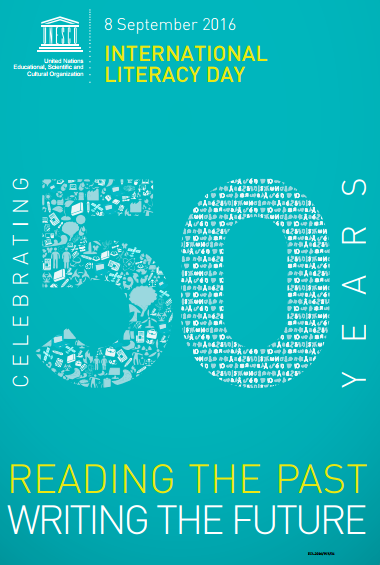
ILD 2016 infographic
credits: UNESCO

For 50 years, UNESCO has been celebrating International Literacy Day by reminding the international community that literacy is a human right and the foundation of all learning. 

Now International Literacy Day is celebrated worldwide, bringing together governments, multi-and bilateral organizations, NGOs, private sectors, communities, teachers, learners and experts in the field. 


"Illiteracy remains synonymous with exclusion and poverty -- we must turn this around."
Irina Bokova, message 2016
On this day also International Literacy Prizes are awarded to people with outstanding solutions that can drive literacy towards achieving the 2030 Education Agenda. This year the focus is on innovation.

This is the first year of implementation of the 2030 Agenda for Sustainable Development. In this context the vision of literacy is aligned with lifelong learning opportunities with special focus on youth and adults


Goal 4
credits: Elyx Yak

Literacy is a part of Sustainable Development Goal 4, which aims to “ensure inclusive and equitable quality education and promote lifelong learning opportunities for all”. The target is that by 2030 all youth and a substantial proportion of adults, both men and women, achieve literacy and numeracy (SDG Target 4.6).


 Education:

Literacy is a fundamental human right and the foundation for lifelong learning. It is fully essential to social and human development in its ability to transform lives. For individuals, families, and societies alike, it is an instrument of empowerment to improve one’s health, one’s income, and one’s relationship with the world. 


Activities: some ideas

  • Use any increased flexibility offered in the curriculum to respond to issues as they arise.
  • Provide space for teachers and students to discuss and reflect on these issues.
  • Pupils get a lot of their information about global issues from the media so help them to interrogate this information critically and consider a range of perspectives.
A good quality basic education equips pupils with literacy skills for life and further learning; literate parents are more likely to send their children to school; literate people are better able to access continuing educational opportunities; and literate societies are better geared to meet pressing development.
Ideas + :

Whether it’s reading or writing, literacy is an outlet to an untouchable world – our imagination. 


Readathon:
  • Host a friendly reading challenge to spark students’ interest. Encourage children to read as many books as possible during this month and have them track their progress. Their efforts can be sponsored by teachers, family and friends or by incentives created through school library, local libraries or bookshops.

Host a speaker or display a video:

  • Invite a local role model or author to discuss the impact literacy has had on their lives. 
  • Discuss with the students the impact of literacy in role model, actor/actress, writer success?

Of course a writer is always curious to know the books read by the students and their favorite authors. This is another idea. I practiced along the years teaching face-to-face.  


@UNESCO


Resources 4Teachers: 


Download ILD 2016 infographic

New publications on Literacy

Promoting Literacy over Five Decades. A Concise Review


Find further ideas and activities for different levels or curricula on Unesco website Education/ Literacy; my posts International Literacy 2015International Literacy Day 2014 and other posts on education and reading.

"Literacy is vital for poverty eradication, for gender equality, for more inclusive and sustainable societies."

Irina Bokova, message 2016


G-Souto

08.09.2016
Copyright © 2016G-Souto'sBlog, gsouto-digitalteacher.blogspot.com®

Creative Commons License
Schools : International Literacy Day : 50th Anniversary bG-Souto is licensed under a Creative Commons Attribution-NonCommercial-NoDerivatives 4.0 International License.

Wednesday, September 7, 2016

Rentrée 2016 : Parlons de l'apprentissage des langues vivantes


illustration: Luna Joulia

Vous connaissez tout sur la Rentrée 2016. Rien qu'à lire ou réviser sur BlogSkidz Rentrée 2016? Eh oui! Sous le signe des nouveautés et de la sécurité.


Infographie Le collège 2016
crédits: Ministère de l'education nationale

La réforme du collège, ainsi que celle des programmes du CP jusqu’à la 3e. Mais aussi des nouveautés pour développer le numérique, qui concernent les élèves de tous les niveaux, et des mesures de sécurité renforcées.

Consultez quand même la page du Ministère de l'éducation nationale Tout savoir sur l'année scolaire 2016-2017.


Infographie Le plan numérique
crédits: Ministère de l'education nationale

Parlons maintenant de l'Apprentissage des langues vivantes. N'oublions pas qu'en septembre on célèbre la Journée des langues européennes, en plus.

Et que suis pour les Humanités aux écoles, lycées et université.

L'essentiel:

  • L’amélioration des compétences des élèves français en langues vivantes est une priorité. L’apprentissage des langues tient en effet une place fondamentale dans:

La construction de la citoyenneté; 

L’enrichissement de la personnalité;

L’ouverture au monde. 


Il favorise également l’employabilité des jeunes en France et à l’étranger.


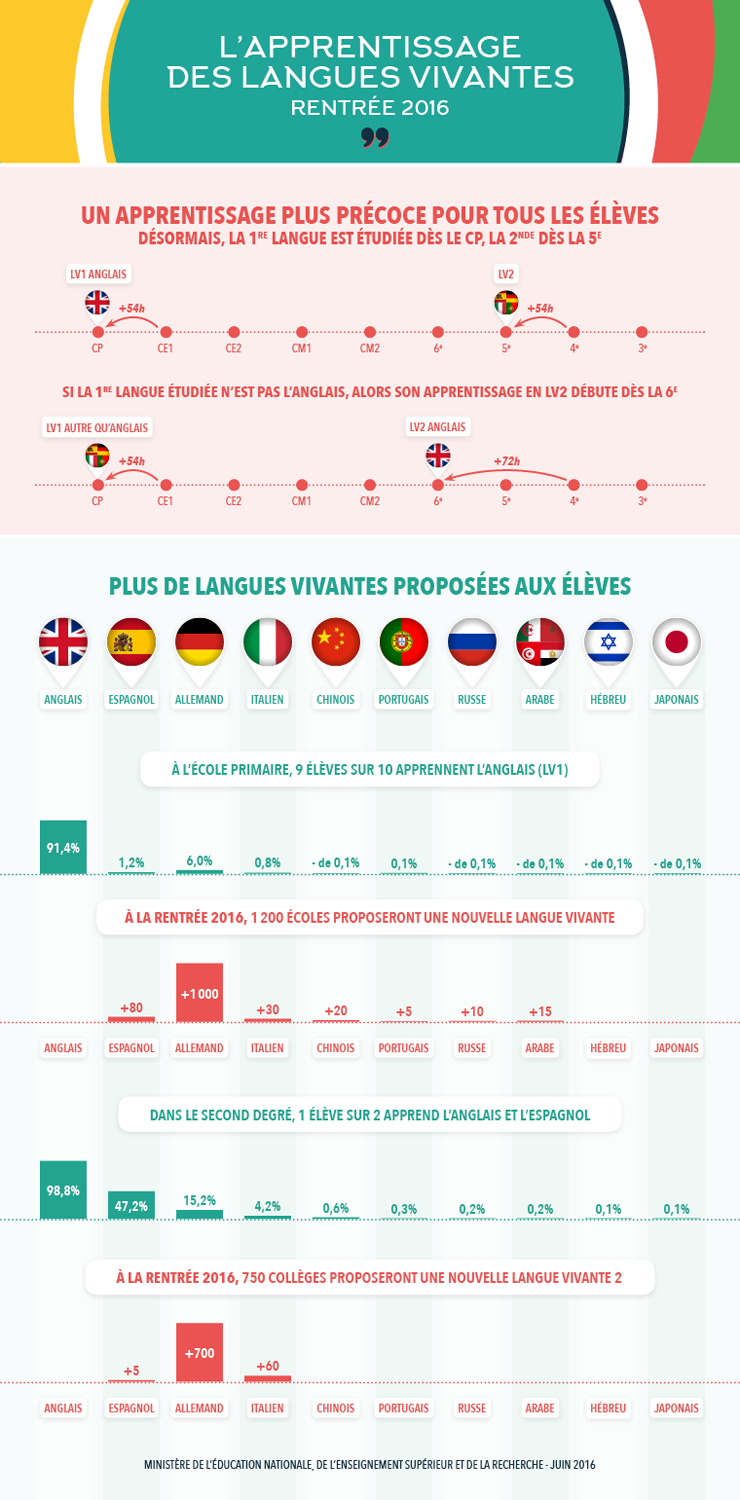
Infographie 1: L'apprentissage des langues vivantes
crédits: Ministère de l'education nationale

  • La ministre a impulsé une stratégie nationale pour les langues vivantes qui repose sur:

Un apprentissage plus précoce (LV1 dès le CP, LV2 dès la 5e); 

Une offre de langue plus diversifiée et continue;

Une plus grande mobilité des élèves.


Infographie 2: L'apprentissage des langues vivantes
crédits: Ministère de l'education nationale

Tout savoir sur l'apprentissage des langues vivantes à partir de la rentrée 2016 et sur la fin des enseignements de langue et de culture d'origine (Elco) en deux infographies.

 Stratégie langues vivantes : retrouvez le dossier complet

Les nouvelles cartes academiques des langues vivantes

  • Mieux apprendre les langues vivantes

  • Mieux enseigner les langues vivantes

  • Dynamiser la mobilite internationale des eleves au service de leur reussite


Dossier Stratégie Langues Vivantes
crédits: Ministère de l'education nationale

A consulter sans faute le Dossier complet: nouvelles cartes académiques des langues vivantes; mieux apprendre les langues; mieux les enseigner; mobilité internationale des élèves...

"Aborder l’apprentissage des langues vivantes étrangères et régionales, la diversité linguistique et la mobilité internationale qui sont au coeur de notre stratégie pourrait se faire de bien des manières. En rappelant que dans une époque marquée par la mondialisation, la connaissance des langues vivantes s’impose non seulement en termes d’insertion professionnelle et de compétences nécessaires pour aborder le monde d’aujourd’hui, mais aussi pour s’inscrire dans une vision d’ensemble qui transcende les frontières géographiques et nationales. Je débuterai cependant par une citation de Goethe : "Wer fremde Sprachen nicht kennt, weiß nichts von seiner eigenen" (Maximen und Refexionen, II, Nr.23, 91.), ce que l’on pourrait traduire par "Celui qui ne connaît pas les langues étrangères ne connaît rien de sa propre langue.". Il nous rappelle que l’apprentissage d’une langue vivante est aussi une voie par laquelle mieux appréhender la langue française, et, plus généralement, une véritable richesse."

Najat Vallaud-Belkacem, ministre de l'Education nationale


Une offre linguistique diversifiée:


Plus de 5 500 écoles élémentaires proposent un enseignement de langue vivante autre que l’anglais à la rentrée 2016, soit 1 200 écoles de plus.
La circulaire relative à la carte des langues vivantes du 20 octobre 2015 a fixé un double objectif aux nouvelles cartes académiques des langues : proposer une offre linguistique diversifiée et veiller à la cohérence et à la lisibilité des parcours linguistiques des élèves. 

  • La carte des langues a pour objectif de favoriser la pluralité des langues enseignées dans le système éducatif et la continuité des parcours linguistiques de l’école au lycée. 
  • Les réseaux d’éducation prioritaire (REP et REP+) ont constitué une cible prioritaire pour le développement d’une offre linguistique diversifiée dans le premier degré et la mise en place de dispositifs bilangues de continuité au collège. 
  • Une carte de géolocalisation de l’offre de langues vivantes des collèges sera mise à disposition sur le site de l’Onisep début mars 2016.


Cartoon: François Maret

Bon, je crois que vous avez tous, les enseignants, les nouveaux et tous les autres enseignants de langues l'essentile sur l'apprentissage des langues vivantes. Il faut bien sûr lire attentivement tout le dossier (lien en haut), discuter vos doutes avec les enseignants senior pour bien s'informer et comprendre toutes les nouveautés sur l'apprentissage des langues vivantes 2016-2017.

Outils enseignants langues vivantes:

  • Le Portail "langues vivantes" à destination des professeurs de langues vivantes : un outil indispensable pour enseigner, s’informer, se former et suivre les actualités de sa discipline.

  • L'Éduthèque: une offre très large de ressources authentiques.

Les jeunes enseignants peuvent participer au Quiz (Le Monde) Connaissez-vous les nouveaux programmes scolaires. Très simple et ça peut vous aider à réviser les nouveautés année scolaire 2016-2017.

Mes pensées:

Je ne suis pas enseignante en France. Ça me donne quand même la possibilité de questionner "l'effort exceptionnel en faveur de l'apprentissage de l'allemand" ou bien l'offre plus élargie de l'anglais et de l'espganol, puisque comme enseignante en plusieurs langues, je crois qu'elles sont toutes aussi importantes.

Je me congratule par la proposition du portugais, comme nouvelle langue vivante à lécole, bien qu'en minorité. Il y a un numéro énorme de portugais qui vivent en France. Avant des gens de niveau de scolarité élémentaire. Depuis 2011, des milliards de jeunes diplômés université dans tous les domaines, mais aussi de chercheurs et scientistes.

Mais je suis tout à fait d'accord avec Michel Serres:

"Les langues sont un trésor." 

Michel Serres, Atlas, Parois Flammarion, 1996


Il nous appartient de le transmettre à tous nos élèves. Je suis sûre que vous leur transmettra.

G-Souto

07.09.2016
Copyright © 2016G-Souto'sBlog, gsouto-digitalteacher.blogspot.com®

Creative Commons License
Rentrée 2016 : Parlons de l'apprentissage des langues vivantes bG-Souto is licensed under a Creative Commons Attribution-NonCommercial-NoDerivatives 4.0 International License.